Wednesday, April 30, 2014

Top 5 Long Term Stocks To Watch For 2015

The following video is from Tuesday's Investor Beat,�in which host Chris Hill and analysts Jason Moser and Jeff Fischer dissect the hardest-hitting investing stories of the day.

Home Depot (NYSE: HD  ) hits a new all-time high. After rising 300% in six months,�SolarCity (NASDAQ: SCTY  ) suffers a big fall. Medtronic (NYSE: MDT  ) moves higher after strong fourth-quarter earnings. And Carnival Cruise Lines (NYSE: CCL  ) falls after lowering guidance for the rest of 2013. In this installment of Investor Beat, Motley Fool analysts Jeff Fischer and Jason Moser analyze four stocks making moves.

The best investing approach is to choose great companies and stick with them for the long term. The Motley Fool's free report "3 Stocks That Will Help You Retire Rich" names stocks that could help you build long-term wealth and retire well, along with some winning wealth-building strategies that every investor should be aware of.�Click here now�to keep reading.

Top 5 Long Term Stocks To Watch For 2015: Rochester Medical Corporation(ROCM)

Rochester Medical Corporation engages in the development, manufacture, and marketing of PVC-free and latex-free urinary continence and urine drainage care products for the home and acute care markets. Its home care products include a line of silicone and latex male external catheters for managing male urinary incontinence; intermittent catheters for managing both male and female urinary retention, including Magic 3 line of silicone intermittent catheters; and the FemSoft Insert, a soft, liquid-filled, urethral insert for managing stress urinary incontinence in adult females. The company manufactures male external catheters in six models, including UltraFlex, Pop-On, Wide Band, Natural, Clear Advantage, and Transfix catheters; and intermittent catheters in four versions that include standard, antibacterial, hydrophilic, and antibacterial personal catheters. Its acute care products include a line of standard Foley catheters and Strata brand of Foley catheters; and Strata-NF Catheter, an antibacterial Foley catheter that reduces the incidence of hospital acquired urinary tract infection. The company?s primary customers include distributors, extended care facilities, and individual hospitals and healthcare institutions. It markets its products under the Rochester Medical brand name through a direct sales force in the United States, the United Kingdom, and the Netherlands, as well as through independent distributors in other international markets. The company also supplies its products to various medical product companies for sale under private label brands owned by these companies. Rochester Medical Corporation was founded in 1988 and is headquartered in Stewartville, Minnesota.

Advisors' Opinion:
  • [By Seth Jayson]

    Calling all cash flows
    When you are trying to buy the market's best stocks, it's worth checking up on your companies' free cash flow once a quarter or so, to see whether it bears any relationship to the net income in the headlines. That's what we do with this series. Today, we're checking in on Rochester Medical (Nasdaq: ROCM  ) , whose recent revenue and earnings are plotted below.

Top 5 Long Term Stocks To Watch For 2015: Kulicke and Soffa Industries Inc.(KLIC)

Kulicke and Soffa Industries, Inc. designs, manufactures, and sells capital equipment and expendable tools used to assemble semiconductor devices, including integrated circuits, high and low powered discrete devices, light-emitting diodes, and power modules. It also services, maintains, repairs, and upgrades its equipment. The company operates in two segments, Equipment and Expendable Tools. The Equipment segment manufactures and sells a line of ball bonders, heavy wire wedge bonders, stud bumpers, and die bonders. Its Ball bonders are used to connect very fine wires, primarily made of gold or copper, between the bond pads of the semiconductor device or die, and the leads on its package; Heavy wire wedge bonders are used in the power semiconductor and automotive power module markets; and Die bonders are used to attach a die to the substrate or lead frame, which will house the semiconductor device. This segment?s Stud bumpers mechanically apply bumps to die, while still in the wafer format, for some variants of the flip chip assembly process. The Expendable Tools segment manufactures and sells various expendable tools for a range of semiconductor packaging applications. Its products include capillaries, bonding wedges, and saw blades. The company?s customers primarily comprise semiconductor device manufacturers, outsourced semiconductor assembly and test providers, other electronics manufacturers, and automotive electronics suppliers in the United States and the Asia/Pacific region. Kulicke and Soffa Industries sells its products through manufacturers? representatives and distributors. The company was founded in 1951 and is headquartered in Singapore.

Advisors' Opinion:
  • [By Jake L'Ecuyer]

    Equities Trading UP
    Kulicke and Soffa Industries (NASDAQ: KLIC) shares shot up 8.95 percent to $13.76 after the company reported upbeat Q2 earnings and issued a strong Q3 revenue forecast.

  • [By Brian Pacampara]

    Based on the aggregated intelligence of 180,000-plus investors participating in Motley Fool CAPS, the Fool's free investing community, chip equipment maker Kulicke and Soffa Industries (NASDAQ: KLIC  ) has earned a coveted five-star ranking.

Top 5 Prefered Stocks For 2015: VocalTec Communications Ltd.(CALL)

magicJack VocalTec Ltd. provides voice over Internet protocol services over various platforms. It also offers magicJack, a competitive local exchange carrier. The company was formerly known as VocalTec Communications Ltd. and changed its name to magicJack VocalTec Ltd. on May 20, 2011. magicJack VocalTec Ltd. is based in Netanya, Israel.

Advisors' Opinion:
  • [By Will Ashworth]

    Hedge fund manager Whitney Tilson believes magicJack VocalTec (CALL) ��� is the kind of growth story that investors could really fall in love with.��/p>

Top 5 Long Term Stocks To Watch For 2015: TECO Energy Inc.(TE)

TECO Energy, Inc., an electric and gas utility company, through its subsidiaries, engages in the generation, purchase, transmission, distribution, and sale of electric energy. It provides retail electric service to approximately 672,000 customers in West Central Florida with a net winter system generating capability of 4,684 megawatts. The company also engages in the purchase, distribution, and marketing of natural gas. It serves approximately 336,000 residential, commercial, industrial, and electric power generation customers in Florida. In addition, the company owns mineral rights, owns or operates surface and underground mines, and owns interests in coal processing and loading facilities. TECO Energy, Inc. was founded in 1899 and is headquartered in Tampa, Florida.

Advisors' Opinion:
  • [By Justin Loiseau]

    With an enviable 11% ROE, regulated utility earnings continue to prove a cash cow for NextEra. TECO Energy (NYSE: TE  ) also operates a Florida regulated utility, Tampa Electric, but its expectations of sub-9% ROE for 2013 don't offer the same earnings NextEra enjoys.

  • [By Justin Loiseau]

    AEP relies on coal for about 66% of its generating capacity, comparable to TECO Energy's (NYSE: TE  ) 61% coal capacity. TECO takes its coal cravings a step further with vertical integration, pulling 9 million tons of solid black gold annually from its Appalachian mines.

Top 5 Long Term Stocks To Watch For 2015: Waste Management Inc.(WM)

Waste Management, Inc., through its subsidiaries, provides waste management services to residential, commercial, industrial, and municipal customers in North America. It offers collection, transfer, recycling, and disposal services. The company also owns, develops, and operates waste-to-energy and landfill gas-to-energy facilities in the United States. Its collection services involves in picking up and transporting waste and recyclable materials from where it was generated to a transfer station, material recovery facility, or disposal site; and recycling operations include collection and materials processing, plastics materials recycling, and commodities recycling. In addition, it provides recycling brokerage, which includes managing the marketing of recyclable materials for third parties; and electronic recycling services, such as collection, sorting, and disassembling of discarded computers, communications equipment, and other electronic equipment. Further, the company e ngages in renting and servicing portable restroom facilities to municipalities and commercial customers under the Port-o-Let name; and involves in landfill gas-to-energy operations comprising recovering and processing the methane gas produced naturally by landfills into a renewable energy source, as well as provides street and parking lot sweeping services. Additionally, it offers portable self-storage, fluorescent lamp recycling, and medical waste services for healthcare facilities, pharmacies, and individuals, as well as provides services on behalf of third parties to construct waste facilities. The company was formerly known as USA Waste Services, Inc. and changed its name to Waste Management, Inc. in 1998. Waste Management, Inc. was incorporated in 1987 and is based in Houston, Texas.

Advisors' Opinion:
  • [By Helix Investment Research]

    We note that Keating Capital's co-investors in many of its portfolio companies are not simply other venture capital or existing investors, but strategic investors as well. Examples include Agilyx, where Waste Management (WM) is a co-investor, BrightSource, where Chevron (CVX) and BP (BP) are co-investors, Kabam, where Google (GOOG) and Intel (INTC) are co-investors, or Tremor Video (TRMR), where Time Warner (TWX) is a co-investor. As of the end of Q2 2013, 9 (excluding Jumptap) of Keating Capital's portfolio companies had unrealized gains, with an average gain of 25.6% (again excluding Jumptap, which had unrealized gains of 8% as of the end of Q2 2013). The remaining 6 companies had an average loss of 44.46%. However, on an overall basis, Keating Capital's portfolio currently has an average unrealized gain of 2.15%. While this is not a large gain, we note that the bulk of Keating Capital's profits are realized upon exiting an investment in conjunction with the portfolio company's IPO or sale. Furthermore, portions of Keating Capital's portfolio are defended by structurally protected appreciation clauses that the company has struck with its portfolio companies, clauses that are not reflected on its balance sheet. These clauses, which are negotiated between Keating Capital and its portfolio companies, allow the company to receive shares in the portfolio company's IPO at a discount, or grant it warrants to purchase additional shares in an IPO for a nominal price. Since inception, Keating Capital has negotiated structurally protected appreciation clauses in 11 of the 20 companies it has invested in. As of the end of Q2 2013, 6 of Keating Capital's 15 portfolio companies were protected by structurally protected appreciation clauses, representing $22 million in total capital (almost 43% of the company's invested capital), thereby entitling Keating Capital to a weighted-average aggregate value of 1.9x its investment at the time of an IPO.

  • [By Selena Maranjian]

    It can be good, though, with kids, to add a few individual company stocks to the mix, to keep things more interesting. A solid, dividend-paying blue chip such as Waste Management (NYSE: WM  ) can be a smart choice, in part because it's relatively easy to understand. It's reliable because garbage collection is likely to be in great demand for a long time, and the company has become a major recycler, too, even generating energy from some waste.

Tuesday, April 29, 2014

4 Big Stocks Getting Big Attention

BALTIMORE (Stockpickr) -- Put down the 10-K filings and the stock screeners. It's time to take a break from the traditional methods of generating investment ideas. Instead, let the crowd do it for you.

>>5 Stocks Ready to Pop on Bullish Earnings

From hedge funds to individual investors, scores of market participants are turning to social media to figure out which stocks are worth watching. It's a concept that's known as "crowdsourcing," and it uses the masses to identify emerging trends in the market.

Crowdsourcing has long been a popular tool for the advertising industry, but it also makes a lot of sense as an investment tool. After all, the market is completely driven by the supply and demand, so it can be valuable to see what names are trending among the crowd.

While some fund managers are already trying to leverage social media resources like Twitter to find algorithmic trading opportunities, for most investors, crowdsourcing works best as a starting point for investors who want a starting point in their analysis. Today, we'll leverage the power of the crowd to take a look at some of the most active stocks on the market today.

>>5 Mega-Cap Stocks to Trade for Gains

These "most active" names are the most heavily-traded names on the market -- and often, uber-active names have some sort of a technical or fundamental catalyst driving investors' attention on shares. And when there's a big catalyst, there's often a trading opportunity.

Without further ado, here's a look at today's stocks.

AstraZeneca


Nearest Resistance: N/A

Nearest Support: $68

Catalyst: Pfizer Acquisition Bid

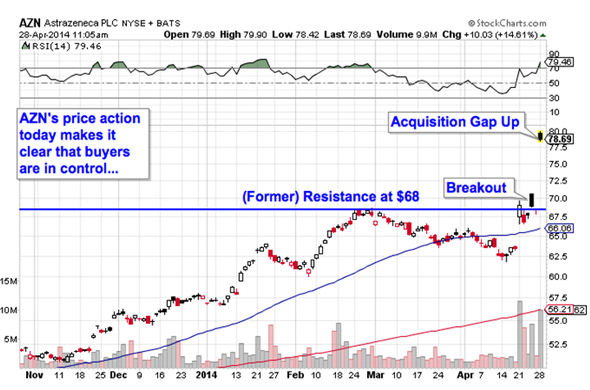
First up is AstraZeneca plc (AZN), the $100 billion drugmaker. AZN is up more than 14% this afternoon after Pfizer (PFE) confirmed that it was still pursuing an acquisition offer following its failed bid in January. At the start of the year, AstraZeneca rejected an acquisition offer that valued the firm at approximately $100 billion, and shares have rallied on hopes that a sweeter deal will come along. That makes for the second straight week of major pharmaceutical M&A activity moving the markets.

From a technical standpoint, AZN started looking bullish late last week thanks to a breakout through $68 resistance. Now that's a support level for shares. Today's price action is a strong indication that buyers are in control here, but the event risk of a lackluster acquisition offer does put somewhat of a damper on AZN's upside from here. More upside still looks probable in AZN, but it's going to be limited by the size of an acquisition price that PFE can swallow.

Pfizer


Nearest Resistance: $33

Nearest Support: $30

Catalyst: AstraZeneca Acquisition Bid

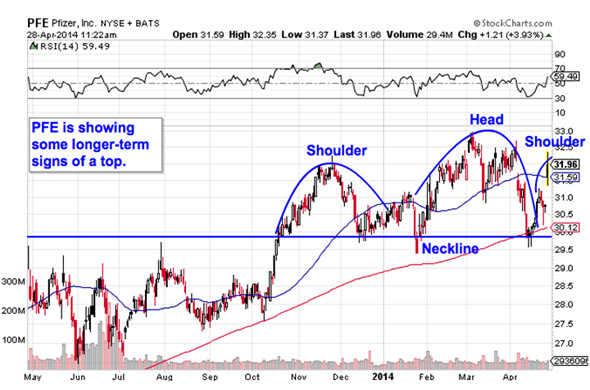
Not surprisingly, Pfizer (PFE) is getting its fair share of trading volume on news of the acquisition attempt. PFE is up almost 4% this afternoon, gapping higher as investors anticipate the potential for big combination advantages between the two major pharma firms.

But zoom out a little longer-term, and Pfizer's price action starts to look a little less auspicious. In fact, after rallying hard since the middle of last summer, this stock is starting to show traders signs of a head and shoulders top. The neckline at $30 is the breakdown level for Pfizer; if shares fail to catch a bid at that level in May, then this name becomes a sell.

Charter Communications


Nearest Resistance: $140

Nearest Support: $120

Catalyst: Q1 Earnings

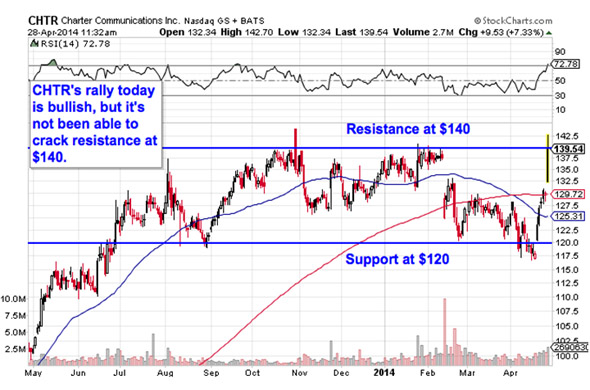
Charter Communications (CHTR) is up more than 7% this afternoon, following the firm's first quarter earnings call. The firm lost 35 cents per share for the quarter, widely missing analysts' 10-cent profit expectations. But shares are rallying despite the miss on an earlier announcement that Comcast (CMCSA) will be selling Charter nearly 4 million subscribers. That big change to Charter's business is the context that investors are using to judge this quarter's earnings call.

Technically, Charter has been consolidating sideways in a wide-ranging channel between $120 and $140. So while today's move higher is pressing CHTR against the top of that channel, it still hasn't exited. A breakout above $140 is a buy signal for Charter -- it's a level that buyers haven't been able to sustain beyond intraday.

Bank of America

Nearest Resistance: $15.75

Nearest Support: $13.75

Catalyst: Accounting Error

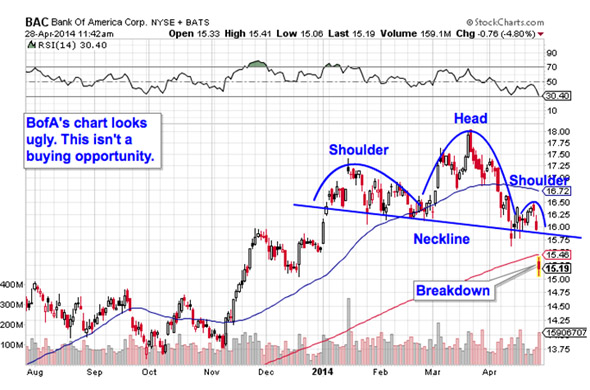
Oops -- Bank of America (BAC) announced that it made an incorrect adjustment on some investments that it acquired long with Merrill Lynch in the wake of the Great Recession. Because of the error, the Federal Reserve is ordering BofA to suspend share buybacks and planned dividend hikes until it resubmits a fresh capital analysis for review. Investors are selling off Bank of America this afternoon, pushing shares down around 5% as I write.

That selling isn't hugely surprising. BofA has been forming a textbook head and shoulders top for the last four months, a bearish reversal pattern that triggered on today's slip through $15.75. Put simply, buyers were exhausted in BAC, and sellers are in control now.

Today's drop isn't a buying opportunity -- it's a warning shot. BofA has more meaningful support down at $13.75.

To see these stocks in action, check out the at Most-Active Stocks portfolio on Stockpickr.


-- Written by Jonas Elmerraji in Baltimore.


RELATED LINKS:


>>3 Stocks Spiking on Unusual Volume


>>5 Toxic Stocks to Watch Out For


>>5 Stocks Poised for Breakouts

Follow Stockpickr on Twitter and become a fan on Facebook.

At the time of publication, author had no positions in the names mentioned.

Jonas Elmerraji, CMT, is a senior market analyst at Agora Financial in Baltimore and a contributor to

TheStreet. Before that, he managed a portfolio of stocks for an investment advisory returned 15% in 2008. He has been featured in Forbes , Investor's Business Daily, and on CNBC.com. Jonas holds a degree in financial economics from UMBC and the Chartered Market Technician designation.

Follow Jonas on Twitter @JonasElmerraji


Monday, April 28, 2014

Netflix's Growth Story Is Not Over

Brett Icahn and fund co-manager David Schechter are of the opinion that Netflix (NFLX) can rise further as it accelerates its global expansion. Carl Icahn (Trades, Portfolio) has stated that he cut his Netflix position because it had become too big.The claims of Icahn Jr. and Schechter also deserve a closer look, as despite trading at a P/E of more than 400 both are bullish on the company. It looks like that the two of them are analyzing Netflix along the same lines as MKM Partners, which had upgraded Netflix's price target from $285 to $370 last year and stated that its market cap could reach a whopping $75 billion by 2020.In my opinion, MKM's valuation, although wildly positive, shouldn't be ruled out. Even if the company couldn't achieve the projected $75 billion in market cap, it should get close to the figure. The reasons behind this bullish thesis aren't hard to find. First, according to MKM analyst Rob Sanderson, the video streaming market in the U.S. is worth $200 billion and Netflix's trailing twelve months' revenue is only $4.14 billion. This means that Netflix has a lot of room to grow revenue.What would drive growth?The company has been adding subscribers at a pretty good rate. It saw an addition of 1.3 million new subscribers in the U.S. in the previous quarter, near the higher end of its guidance of 690,000-1.49 million. More impressively, Netflix's international subscribers jumped a whopping 1.44 million. In this way, Netflix ended the quarter with more than 40 million subscribers.The company's strategy of making its original content along with carrying content from other studios has worked well. This helped Netflix bring in revenue of $1.1 billion, at par with estimates, while earnings of 52 cents per share were well ahead of the 49 cents consensus.Netflix has now overtaken HBO in terms of subscribers as it aims to become a web-based television network. It is reportedly engaged in negotiations with U.S. cable TV providers such as Suddenlink Communications, Cox Communications, RCN Tele! com Services, and Atlantic Broadband Finance for content. If Netflix succeeds in getting itself onto cable networks and is integrated into set-top boxes, its usage would most probably increase.A big marketEven MKM Partners' analysis suggests that the "economics of entertainment video will be redistributed with the shift to Internet-delivered services." That's probably the reason why Netflix's partnership with cable operators such as Virgin in the U.K. and ComHem in Sweden could turn out to be lucrative. Sanderson states that cable operators in the U.K. view Netflix as a "must-have" service, and as the company moves into other international markets in the future, its international subscriber count can exceed its U.S. subscriber base.In countries such as India, where broadband penetration is still low, Netflix can find a big market. The number of households with a TV in the country is projected to multiply from around 160 million at present to 200 million in the next four years. This growth will be driven by an increase in cable digitization and direct-to-home services. Penetration in such mass markets could be a big boon for Netflix and help it grow its revenue substantially.Analysts are also bullish about the company's prospects with as many as 12 brokerages raising their price targets on the stock. Analysts at Morgan Stanley expect Netflix to add 4.2 million subscribers in the fourth quarter. Looking forward, CEO Reed Hastings is of the opinion that Netflix can reach 60 million to 90 million subscribers internationally in the future.ConclusionNetflix has a big playing field ahead of it and it isn't hard to see why Brett Icahn and Schechter are still bullish. As I said above, Netflix might not be worth $75 billion by 2020 as MKM suggests, but it can surely continue growing as it taps into more markets and expands its wings.

Currently 0.00/512345

Rating: 0.0/5 (0 votes)

Email FeedsSubscribe via Email RSS FeedsSubscribe RSS Comments Please leave your comment:
More GuruFocus Links
Latest Guru Picks Value Strategies
Warren Buffett Portfolio Ben Graham Net-Net
Real Time Picks Buffett-Munger Screener
Aggregated Portfolio Undervalued Predictable
ETFs, Options Low P/S Companies
Insider Trends 10-Year Financials
52-Week Lows Interactive Charts
Model Portfolios DCF Calculator
RSS Feed Monthly Newsletters
The All-In-One Screener Portfolio Tracking Tool
iPhone App MORE GURUFOCUS LINKS
Latest Guru Picks Value Strategies
Warren Buffett Portfolio Ben Graham Net-Net
Real Time Picks Buffett-Munger Screener
Aggregated Portfolio Undervalued Predictable
ETFs, Options Low P/S Companies
Insider Trends 10-Year Financials
52-Week Lows Interactive Charts
Model Portfolios DCF Calculator
RSS Feed Monthly Newsletters
The All-In-One Screener Portfolio Tracking Tool
NFLX STOCK PRICE CHART 322.08 (1y: +50%) $(function(){var seriesOptions=[],yAxisOptions=[],name='NFLX',display='';Highcharts.setOptions({global:{useUTC:true}});var d=new Date();$current_day=d.getDay();if($current_day==5||$current_day==0||$current_day==6){day=4;}else{day=7;} seriesOptions[0]={id:name,animation:false,color:'#4572A7',lineWidth:1,name:name.toUpperCase()+' stock price',threshold:null,data:[[1367211600000,215.013],[1367298000000,216.07],[1367384400000,212.91],[1367470800000,214.49],[1367557200000,213.45],[1367816400000,210.69],[1367902800000,206.25],[1367989200000,208.61],[1368075600000,216.41],[1368162000000,217.694],[1368421200000,229.379],[1368507600000,233.97],[1368594000000,243.4],[1368680400000,237.03],[1368766800000,239],[1369026000000,239.55],[1369112400000,237.09],[1369198800000,228.56],[1369285200000,226.18],[1369371600000,228.74],[1369717200000,214.19],[1369803600000,215.34],[1369890000000,222.66],[1369976400000,226.25],[1370235600000,221.97],[1370322000000,225.31],[1370408400000,223.46],[1370494800000,217.74],[1370581200000,220.22],[1370840400000,220.93],[1370926800000,214.46],[1371013200000,207.64],[1371099600000,215.39],[1371186000000,213.99],[1371445200000,229.23],[1371531600000,228.83],[1371618000000,232.31],[1371704400000,223.52],[1371790800000,216.9],[1372050000000,215.6],[1372136400000,212.9],[1372222800000,212.1],[1372309200000,214.97],[1372395600000,211.09],[1372654800000,224.28],[1372741200000,221.46],[1372827600000,220.91],[1373000400000,225.1],[1373259600000,233.1],[1373346000000,247.382],[1373432400000,243.82],[1373518800000,244.17],[1373605200000,257.261],[1373864400000,257.98],[1373950800000,260.48],[1374037200000,267.92],[1374123600000,266.41],[1374210000000,264.576],[1374469200000,261.96],[1374555600000,250.26],[1374642000000,241.3],[1374728400000,246.74],[1374814800000,246.31],[1375074000000,244.96],[1375160400000,243.76],[1375246800000,244.484],[1375333200000,249.12],[1375419600000,246.18],[1375678800000,253.84],[1375765200000,255.9],[1375851600000,249.21],[1375938000000,250.4],[1376024400000,252.75],[1376283600000,256.6],[1376370000000,259.19],[1376456400000,261.81],[1376542800000,253.41],[1376629200000,258.87],[1376888400000,259.78],[1376974800000,273.29],[1377061200000,270.37],[1377147600000,269.75],[1377234000000,278.36],[137749! 3200000,282.72],[1377579600000,276.04],[1377666000000,283.36],[1377752400000,287.85],[1377838800000,283.91],[1378184400000,289],[1378270800000,292.43],[1378357200000,295.11],[1378443600000,291.54],[1378702800000,294.15],[1378789200000,313.06],[1378875600000,308.3],[1378962000000,301.406],[1379048400000,305.65],[1379307600000,302.16],[1379394000000,299.55],[1379480400000,306.92],[1379566800000,305.498],[1379653200000,313.83],[1379912400000,302.04],[1379998800000,306.49],[1380085200000,307.14],[1380171600000,313.51],[1380258000000,312.4],[1380517200000,309.21],[1380603600000,324.62],[1380690000000,330.73],[1380776400000,321.72],[1380862800000,327.26],[1381122000000,318.16],[1381208400000,302.32],[1381294800000,288.43],[1381381200000,303.994],[1381467600000,300.848],[1381726800000,324.36],[1381813200000,321.69],[1381899600000,322.878],[1381986000000,330.1],[1382072400000,333.5],[1382331600000,354.99],[1382418000000,322.524],[1382504400000,330.24],[1382590800000,331.22],[1382677200000,328.031],[1382936400000,314],[1383022800000,327.3],[1383109200000,318.14],[1383195600000,322.48],[1383282000000,329.265],[1383544800000,337.6],[1383631200000,341.5],[1383717600000,335.63],[1383804000000,326.86],[1383890400000,334.9],[1384149600000,337.91],[1384236000000,333.73],[1384322400000,335.284],[1384408800000,342.57],[1384495200000,349.76],[1384754400000,341.77],[1384840800000,337.29],[1384927200000,339.52],[1385013600000,348.5],[1385100000000,347.85],[1385359200000,350.24],[1385445600000,355.2],[1385532000000,362.49],[1385704800000,365.8],[1385964000000,363.92],[1386050400000,362.94],[1386136800000,356.27],[1386223200000,358.06],[1386309600000,354.44],[1386568800000,355.67],[1386655200000,363.1],[1386741600000,363.98],[1386828000000,373.33],[1386914400000,368.97],[1387173600000,366.31],[1387260000000,374.87],[1387346400000,376.24],[1387432800000,376.74],[1387519200000,375.67],[1387778400000,380.58],[1387864800000,378.39],[1388037600000,376.93],[1388124000000,367.5],[1388383200000,366.99],[1388469600000,368.17],[1388642! 400000,36! 2.82],[1388728800000,363.1],[1388988000000,359.57],[1389074400000,339.5],[1389160800000,340.99],[1389247200000,337.05],[1389333600000,332.14],[1389592800000,336.81],[1389679200000,337.96],[1389765600000,330.38],[1389852000000,331.68],[1389938400000,330.04],[1390284000000,328.71],[1390370400000,333.73],[1390456800000,388.72],[1390543200000,386.08],[1390802400000,381.23],[1390888800000,406.77],[1390975200000,400.42],[1391061600000,404.67],[1391148000000,409.33],[1391407200000,404.38],[1391493600000,405.91],[1391580000000,404.42],[1391666400000,407.91],[1391752800000,429.98],[1392012000000,430.44],[1392098400000,433.99],[1392184800000,428.93],[1392271200000,436.55],[1392357600000,435.51],[1392703200000,436.85],[1392789600000,428.23],[1392876000000,434.95],[1392962400000,432.23],[1393221600000,447],[1393308000000,453.03],[1393394400000,448.79],[1393826400000,445.59],[1393912800000,454.98],[1393999200000,453.5],[1394085600000,450.51],[1394172000000,448.37],[1394427600000,439.95],[1394514000000,437.48],[1394600400000,436.58],[1394686800000,430.06],[1394773200000,424.49],[1395032400000,422.72],[1395118800000,420.25],[1395205200000,420.09],[1395291600000,424.27],[1395378000000,405.99],[1395637200000,378.9],[1395723600000,370.84],[1395810000000,372.28],[

Sunday, April 27, 2014

Top 5 Rising Companies To Watch In Right Now

Top 5 Rising Companies To Watch In Right Now: Infinity Property and Casualty Corporation(IPCC)

Infinity Property and Casualty Corporation, through its subsidiaries, provides personal automobile insurance with a concentration on nonstandard auto insurance in the United States. The company offers personal automobile insurance to individuals; mono-line commercial vehicle insurance to businesses; and classic collector insurance, which provides protection for classic collectible automobiles. It products provide coverage to individuals for liability to others for bodily injury and property damage, and for physical damage to an insured?s own vehicle from collision and various other perils. Infinity distributes its products primarily through a network of independent agencies and brokers. The company was founded in 2002 and is headquartered in Birmingham, Alabama.

Advisors' Opinion:
  • [By John Udovich]

    Auto sales continue to rise and that is good news for small cap auto insurers Infinity Property and Casualty Corp (NASDAQ: IPCC), First Acceptance Corporation (NYSE: FAC) and Atlas Financial Holdings Inc (NASDAQ: AFH) which are focused on niche auto insurance markets. A Yahoo! Autos blog post recently noted that in August, automakers sold 1.5 million new vehicles for the highest rate in years. Moreover, most industry forecasters expect sales to return to the level they hit before the 2008 recession of 16 million vehicles a year. The blog post then went on to note the three forces driving auto sales:

  • source from Top Stocks Blog:http://www.topstocksblog.com/top-5-rising-companies-to-watch-in-right-now.html

Thursday, April 24, 2014

FINRA Approves Broad Changes to Broker Background Checks

The Financial Industry Regulatory Authority’s Board on Thursday approved sweeping changes involving brokers’ background checks.

The FINRA Board approved amendments to FINRA's supervision rule that would expand the obligations of firms to check the background of applicants for registration, including first-time applications as well as transfers, to verify the accuracy and completeness of the information contained in an applicant's Form U4.

Firms would also be required to adopt written procedures in this area that include searching public records.

The Form U4 is the Uniform Application for Securities Industry Registration or Transfer used by FINRA, other self-regulatory organizations (SROs) and states to elicit employment background and disciplinary information to register individuals.

FINRA also said that it plans to perform an initial search of public financial records for all registered representatives and will also conduct a search of publicly available criminal records for all registered individuals who have not been fingerprinted within the last five years.

Once these searches are completed, FINRA said that it will conduct “periodic reviews of public records to ascertain the accuracy and completeness of the information available to investors, regulators and firms.”

These efforts, FINRA stated, "also better position FINRA to assess firm and registered individual compliance with reporting requirements."

FINRA is also considering whether additional data from the Central Registration Depository (CRD) system used by regulators should be included in BrokerCheck. FINRA said that its chief economist has initiated a study to see if there is a meaningful relationship between that data – which includes failed examinations – and broker misconduct.

Top Promising Stocks To Own Right Now

"These are important initiatives to improve the accuracy and totality of details reported on a registered individual’s Form U4,” said Richard Ketchum, FINRA’s chairman and CEO, in a statement. “FINRA would require firms to use publicly available records to verify that information such as criminal and bankruptcy records, civil litigations, judgments and liens are properly reported upon a registered individual's application. FINRA encourages every investor to use BrokerCheck to research the background of individuals they are trusting to invest their money.”

The amendments to the supervision rule will be submitted to the Securities and Exchange Commission for review and approval.

(Related ThinkAdvisor story: FINRA Reverses Schwab Class Action Waiver Decision)

Tuesday, April 22, 2014

America's Favorite Doughnut

America's two favorite doughnut brands are without question Dunkin' Brands (NASDAQ: DNKN  ) and Krispy Kreme Doughnuts (NYSE: KKD  ) . But which brand does America love more? Let's take a look at three tasty stocks -- Krispy Kreme, Dunkin' Brands, and their kissing cousin Starbucks (NASDAQ: SBUX  )  -- to decide.

Dunkin' Brands is by far the world's largest purveyor of doughnuts, but size doesn't mean favorite. The company operates more than 18,000 points of distribution in nearly 60 countries worldwide, including 11,000 Dunkin' Donuts and 7,300 Baskin-Robbins. Meanwhile, the Krispy Kreme hot Original Glazed doughnut can be found in 21 countries, and the company operates 773 stores.

Dunkin' may operate more stores than Krispy Kreme, but everyone knows that both brands sell doughnuts in more places than just their stores. Neither company reports the number of doughnuts sold, so investors will just have to judge the companies on the numbers like they would for any other brand (followed by a thoughtful taste test, of course).

Dunkin' Brands' most recent quarterly earnings per share increased 26.5%, and revenue rose 13.3%. The company enjoyed comparable-store sales growth of 3.5% in the United States. Operating income increased 11.8% to $89.2 million, as the company expanded its operating margin 110 basis points to 48.7%. During the fourth quarter of FY 2013, 309 new restaurants were opened worldwide, which included 149 net new Dunkin' Donuts locations in the United States.

Dunkin' has seen consistent growth in average revenue per store at domestic Dunkin' Donuts locations for the last five years. Investors were also quite happy to learn of a dividend increase of 21.1% from $0.19 to $0.23 and a share-repurchase authorization.

A doughnut in the hand is worth two in the box
There may be more Dunkin' Donuts out there, but Krispy Kreme Doughnuts has carried on an impressive 21 consecutive quarters of positive same-store growth. In the FY 2013 fourth quarter, revenue increased 3.3% to $112.7 million from $109.1 million as same-store sales rose 1.6% for the 21st consecutive quarterly increase. 

For fiscal year 2013, Krispy Kreme brought in revenue of $460.3 million, which represents a 6% increase from the $435.8 million over the prior year. 

The company's adjusted net income increased 37% to $8.3 million, or $0.12 per share. This compares to $6.1 million, or $0.09 per share, in the year-ago period. Krispy Kreme also repurchased $20.5 million worth of common stock in fiscal 2014, leaving $55.7 million in cash on hand.

In comparison, for the year-ago period, the quarter ended May 5, 2013 (Q1 FY 2014), Krispy Kreme Doughnuts beat expectations on revenue and met expectations on earnings per share. Profits increased 33% on 11% revenue growth. The company brought in revenue of $120.6 million, and generally accepted accounting principles reported sales were 11% higher than the prior-year quarter's $108.5 million.

Krispy Kreme also added 80 new locations around the world in 2013, a 6.7% increase in comparable-store sales over 2012.

...And a coffee to go
What's a doughnut without a cup of coffee to dunk it in?

Starbucks also continues to perform well. In the most recent quarter, reported in January, earnings per share increased 24.6%, and revenue increased 11.8% year over year. Global comparable-store sales grew by an impressive 5%. Starbucks' operating margin increased 260 basis points to 19.2%.

Starbucks reported fiscal first quarter EPS of $0.71, up from $0.57 in the year-ago period and beating analysts' expectations of $0.69 in EPS. Revenue hit $4.2 billion, up from $3.8 billion a year ago.

The real evidence of the company's growth and strength was seen with the expansion of 417 new locations during the quarter. There are now 4,000 locations in Asia, 2,000 locations in Europe, the Middle East, and Africa, and 20,000 total locations worldwide to get a caffeine fix. Starbucks currently has 13,279 U.S. stores.

Starbucks continues its plans for global domination by tailoring its menu to appeal to regional tastes. For instance, the Chinese menu includes more green tea-flavored drinks, while younger demographics in the U.S. are courted by mobile- payment devices. Mobile payments now account for up to 10% of the company's in-store purchases in the U.S.

No company is perfect, although each of these companies is a very attractive buy. Each chain has an area it could improve in. For instance, Dunkin' Brands could expand the number of drive-thru units and increase customer service time.

Starbucks could continue to improve its food offerings (can you imagine what would happen if it offered hot, fresh doughnuts?). And it needs to be cautious with price increases. Krispy Kreme has improved from a rough beginning on the stock exchange to becoming a truly formidable stock. The company has strong earnings and impressive management but could do better when it comes to comparable-store growth.

Dunkin' Brands saw comparable-store growth of 3.5%, Starbucks had global growth of 5%, but Krispy Kreme only showed 1.6%. Normally in the restaurant business 1.6% would be considered decent or passable, even strong. But when the competition is at nearly twice that rate, it indicates a great deal of room for improvement. 

And that ultimately answers the question of who makes America's favorite doughnut. It's the company that is building the most new stores and growing sales within existing stores. All three companies are good, strong stocks, but it's Dunkin' Brands that currently wins for the title of America's Favorite Doughnut.

The Motley Fool's completely free report on 3 Dow stocks to buy today
If you're looking for some long-term investing ideas, you're invited to check out The Motley Fool's brand-new special report, "The 3 Dow Stocks Dividend Investors Need." It's absolutely free, so simply click here now and get your copy today.

Why Endocyte Is Poised to Pull Back

Based on the aggregated intelligence of 180,000-plus investors participating in Motley Fool CAPS, the Fool's free investing community, biopharmaceutical company Endocyte (NASDAQ: ECYT  ) has received a distressing two-star ranking.

With that in mind, let's take a closer look at Endocyte and see what CAPS investors are saying about the stock right now.

Endocyte facts

Headquarters (founded)

West Lafayette, Ind. (1995)

Market Cap

$590.7 million

Industry

Pharmaceuticals

Trailing-12-Month Revenue

$49.2 million

Management

Co-Founder/CEO Ron Ellis
Co-Founder/Chief Scientific Officer Philip Low

Return on Equity (average, past 3 years)

(35.3%)

Cash/Debt

$134.8 million / $62.1 thousand

Competitors

Nektar Therapeutics
Sunesis Pharmaceuticals

Sources: S&P Capital IQ and Motley Fool CAPS.

On CAPS, 10% of the 20 All-Star members who have rated Endocyte believe the stock will underperform the S&P 500 going forward.

Just last week, one of those Fools, zzlangerhans, touched on the stock's seemingly unsustainable price run:

Kudos to those who saw the opportunity when Endocyte was beaten down, as the share price rebounded once it became clear that the company would submit vintafolide for accelerated European approval regardless of the negative OS data and partnered the drug with Merck globally on very favorable terms. The stock has gapped up at regular intervals and the latest may be occurring as I write. Nevertheless, I think the valuation has become excessive given the possibility that CHMP might not wish to give a favorable opinion with the topline PFS data from the PROCEED phase III trial of vintafolide expected in H1 2014. Even if CHMP issues a favorable opinion, PROCEED will have to yield positive PFS and likely OS data to maintain approval and have a strong commercial impact. I missed the easy money here but those more fortunate would be wise to take at least some of their profits off the table.

While you can certainly make quick gains in speculative biotech stocks, the best investing approach is to choose great companies and stick with them for the long term. The Motley Fool's free report "3 Stocks That Will Help You Retire Rich" names stocks that could help you build long-term wealth and retire well, along with some winning wealth-building strategies that every investor should be aware of. Click here now to keep reading.

Monday, April 21, 2014

Can Lululemon Break Out to New Highs This Year?

With shares of Lululemon (NASDAQ:LULU) trading around $75, is LULU an OUTPERFORM, WAIT AND SEE, or STAY AWAY? Let's analyze the stock with the relevant sections of our CHEAT SHEET investing framework.

T = Trends for a Stock’s Movement

Lululemon designs, manufactures, and distributes athletic apparel and accessories for women, men, and female youth. It operates in three segments: Corporate-Owned Stores, Direct to Consumer, and Other. The company''s line of apparel include fitness pants, shorts, tops, and jackets for healthy lifestyle activities such as yoga, running, and general fitness. Its fitness-related accessories comprise bags, socks, underwear, yoga mats, instructional yoga DVDs, and water bottles.

Recently, Lululemon posted earnings and revenues figures that beat Wall Street's expectations. Christine Day, Lululemon's CEO, said in a statement: "2013 continues to be the most important and most productive year in Lululemon's history. We have not only worked our way back from the black luon setback, but have also added very talented people in important functions and have taken major steps forward on a number of key fronts, including the expansion of our international and men's businesses and many logistical initiatives. In addition, our exclusive partnership with Noble announced today and additional sources for luon will help to ensure that Lululemon remains a distinct leader in quality and innovation."

T = Technicals on the Stock Chart Are Strong

Lululemon stock has struggled to make significant progress in the past couple of years. The stock is trading near the top end of a two-year range, so it may need to spend some time there. Analyzing the price trend and its strength can be done using key simple moving averages. What are the key moving averages? The 50-day (pink), 100-day (blue), and 200-day (yellow) simple moving averages. As seen in the daily price chart below, Lululemon is trading above its rising key averages, which signals neutral to bullish price action in the near term.

LULU

Source: Thinkorswim

Taking a look at the implied volatility and implied volatility skew levels of Lululemon options may help determine if investors are bullish, neutral, or bearish.

Implied Volatility (IV)

30-Day IV Percentile

90-Day IV Percentile

Lululemon Options

32.56%

40%

39%

What does this mean? This means that investors or traders are buying a significant amount of call and put options contracts as compared to the last 30 and 90 trading days.

Put IV Skew

Call IV Skew

October Options

Flat

Average

November Options

Flat

Average

As of Wednesday, there is average demand from call buyers or sellers and low demand by put buyers or high demand by put sellers, all neutral to bullish over the next two months. To summarize, investors are buying a significant amount of call and put option contracts and are leaning neutral to bullish over the next two months.

E = Earnings Are Increasing Quarter Over Quarter

Rising stock prices are often strongly correlated with rising earnings and revenue growth rates. Also, the last four quarterly earnings announcement reactions help gauge investor sentiment on Lululemon’s stock. What do the last four quarterly earnings and revenue growth (Y-O-Y) figures for Lululemon look like and, more importantly, how did the markets like these numbers?

2013 Q2

2013 Q1

2012 Q4

2012 Q3

Earnings Growth (Y-O-Y)

0.00%

0.00%

48.21%

44.44%

Revenue Growth (Y-O-Y)

21.89%

21.03%

30.68%

37.50%

Earnings Reaction

-5.40%

-17.53%

1.28%

7.26%

Lululemon has seen increasing earnings and revenue figures over the last four quarters. From these numbers, the markets have expected more from Lululemon’s recent earnings announcements.

P = Weak Relative Performance Versus Peers and Sector

How has Lululemon stock done relative to its peers – Nike (NYSE:NKE), Under Armour (NYSE:UA), and Gap (NYSE:GPS) — and sector?

Lululemon

Nike

Under Armour

Gap

Sector

Year-to-Date Return

-2.09%

39.67%

70.20%

31.64%

33.42%

Lululemon has been a poor relative performer, year to date.

Conclusion

Lululemon provides in-demand athletic apparel to consumers across the nation. The company recently reported strong earnings and revenue numbers. However, investors had higher expectations. The stock has not made much progress in recent years and is now trading near the top end of its two-year range. Over the last four quarters, earnings and revenues have been rising, but investors have expected more during recent earnings announcements. Relative to its peers and sector, Lululemon has been a weak year-to-date performer. WAIT AND SEE what Lululemon does this quarter.

Sunday, April 20, 2014

Could the SEC Actually Get Some Teeth?

The Securities & Exchange Commission has some awesome attributes. However, in some areas it has utterly failed us. Hopefully that's about to change, though.

Let's start with the awesome part: The SEC is a priceless repository of key information for investors. I worked at a subcontractor for the SEC in the early '90s. I remember when SEC documents were distributed in paper form. I know from experience that a physical Form S-4 merger document can make quite a doorstop. I also remember the then-revolutionary EDGAR database in its infancy -- an amazing improvement in individual investors' access to company information.

In other words, today's individual investors have an amazing depth of information about potential investments.

However, the SEC falls short in other functions, one of which is extremely significant. After the Depression, the SEC formed to protect investors. When it comes to truly keeping companies' proverbial feet to the fire, it simply hasn't done it lately. The entity has often let companies off scot-free. Even when companies have hit the SEC radar, they've been allowed to settle without admitting wrongdoing.

5 Best Japanese Stocks To Watch Right Now

Recently elected SEC Chair Mary Jo White has made an interesting step in a different direction. In some of its enforcement cases, the agency will now pressure selected companies to admit to wrongdoing. That's far different, and much more impressive, than the old way: letting companies pay up and settle, and never making them admit to or deny having done anything wrong at all.

Don't expect an impressive fireworks display yet
Granted, while the SEC might get some teeth, it's not exactly a full set. In most cases, status quo will still apply. It's a step in the right direction, though, and it may pressure other agencies like the FDIC and the Department of Justice to step up their own practices.

White's move highlights an important, haunting question: Why weren't banks' top managements held more accountable for the financial crisis through real ramifications? In 2009, Tom Gardner, co-founder here at the Fool, had some serious words about the concept of actual jail time for some wrongdoers. The big banks' reckless, risky behavior affected every American one way or another.

These days, the term "too big to fail" has morphed into "too big to jail." Consumer advocates like Massachusetts Senator Elizabeth Warren have been fighting this mind-set among regulators for years.

My Foolish colleague Matt Koppenheffer recently pointed out that some bankers have recently been punished by the SEC for fraud, but they're just community bankers. He went on to explore the facets of why the big ones, the ones we all feel are most culpable for the most damage, have remained unscathed.

The SEC's change will apply to the worst cases, where there's intentional misconduct, harm to many investors, and obstruction of investigations. We know the downsides of this; for example, it's hard to prove intent. "I didn't know" proved to be a major, albeit lame, excuse when the financial crisis put the spotlight on Wall Street's top brass.

Penny-ante penalties
There are many reasons that financial settlements with no admission of wrongdoing are annoying, even beyond the fact that nobody goes to jail or otherwise pays for poor behavior or leadership. These financial hits are usually minute in the grand scheme of big companies' businesses, and that's no disincentive. In other words, such actions not only lack teeth, they hardly even qualify as a slap on the wrist.

Unethical or even criminal behavior can be more profitable than taking the moral high ground, particularly since the financial ramifications tend to be weak at best.

In one example, Wal-Mart (NYSE: WMT  ) has been dealing with regulatory investigations into allegations of international bribery. At this juncture, the giant has disclosed in its regulatory filings that it does not believe that the costs associated with that ongoing situation will be material to its business. Somehow, that's not surprising.

Bank of America (NYSE: BAC  ) has been landing in heaps of trouble lately, bringing back memories of the worst things about the financial crisis and housing crash. The most recent outrage has been allegations that it paid bonuses and even gift cards to employees who foreclosed on homeowners, lying to borrowers and its government rescuer. Meanwhile, New York has also sued HSBC (NYSE: HBC  ) for ignoring state law requiring that banks give homeowners opportunities to modify their loans and avoid losing their homes.

New York's attorney general could also file lawsuits against other banks, including Bank of America, for violating the terms of a settlement related to handling home loans.

Strengthening pressure from every side could help avoid crises and unethical or fraudulent behavior in the first place.

Unleash the watchdogs
Many of us are looking to the SEC to change a lot of things. To give credit where it's due, though, the SEC does have some impressive new tools for investors. The say-on-pay mandate has been a major step for shareholder rights. Proxy votes are finally getting the attention of many corporate managements and boards. Just this week, Target almost lost a say-on-pay vote; its board would be wise to rethink compensation policies since nearly half its shareholders believe CEO compensation is too high.

JPMorgan's Jamie Dimon may have won the vote regarding his dual roles as chairman and CEO, but the fact that it was big news -- not to mention, that there was a possibility shareholders could shoot his chairman role down, even in a non-binding vote -- is a victory of sorts for corporate governance awareness.

Meanwhile, GMI Ratings recently released a report pointing out that investors who spot and heed red flags that could point to fraud could significantly boost their returns. GMI screened out 25% of Russell 3000 companies that received the lowest scores in its fraud-detection analysis, and found a 29% increase in portfolio value over a 10-year period.

In other words, investors need to protect themselves from investing in shoddy businesses, particularly the ones that could end up on a worst-case scenario hit list. And of course, we investors could certainly use some help from the SEC and other financial regulators. A close eye and real repercussions would be helpful.

Hopefully the SEC will continue to take stronger stands in favor of investors' best interests, and more regulators will truly make sure that wrongdoing is acknowledged and punished. If we don't want to give companies incentive to do the wrong thing, that watchdog could use a lot more bite.

Are you part of the 99%? The Motley Fool's new free report highlights three less-than-luxurious stocks the 1% may be overlooking. Just click here to read it now.

Check back at Fool.com for more of Alyce Lomax's columns on environmental, social, and governance issues.

Saturday, April 19, 2014

Capstone Turbine's Make-or-Break Moment Is Here

On Thursday, Capstone Turbine (NASDAQ: CPST  ) will release its latest quarterly results. But lately, investors have already anticipated some huge results from the company, having bid the shares up by about 50% in just the past several weeks. Can Capstone deliver on what investors want to see?

For years, Capstone Turbine has struggled to make its innovative microturbine power systems business more commercially viable, with losses continually plaguing the company and investors suffering repeated disappointments. Will this time bring a happier ending to longtime shareholders? Let's take an early look at what's been happening with Capstone Turbine over the past quarter and what we're likely to see in its quarterly report.

Stats on Capstone Turbine

Analyst EPS Estimate

($0.01)

Year-Ago EPS

($0.03)

Revenue Estimate

$36.3 million

Change From Year-Ago Revenue

21%

Earnings Beats in Past 4 Quarters

1

Source: Yahoo! Finance.

Can Capstone Turbine power up its earnings this quarter?
For their part, analysts haven't budged in recent months on their views of Capstone's earnings, keeping their estimates for both the March quarter and the 2014 fiscal year unchanged. The stock, though, has vaulted higher, with gains of about 30% since early March.

Top US Companies To Buy Right Now

Capstone has had huge potential for a long time, even if it hasn't delivered on that potential. The company's microturbines have tapped into the trend toward on-site power generation, and its flexible-fuel equipment makes it a more viable option for smaller projects that the larger generators that giants General Electric (NYSE: GE  ) and Caterpillar (NYSE: CAT  ) have developed. GE and Caterpillar aim instead for high-efficiency products and have done an excellent job of delivering, with Caterpillar's power-generation equipment reaching 96% efficiency ratings. But Capstone's solutions are better for residential and smaller commercial customers.

Over the past few months, though, Capstone has made progress toward its long-term mission to become profitable. In late February, CONSOL Energy (NYSE: CNX  ) installed one of its microturbines at a gas processing plant, taking coal-bed methane from the plant itself to provide power and generate electricity from waste gas, leading to net benefits in electricity production for CONSOL. Then in April, Capstone did multiple deals, with three orders from the Chinese oil and gas sector to supply power for exploration and production activity, as well an order from a Russian pipeline project and another for electric buses in Denver. Further orders in May have kept the excitement rising for the stock, demonstrating its increasing ability to get attention from customers for a variety of different applications.

What Capstone really needs to demonstrate is its ability to keep ramping up revenue. Expected sales gains of around 20% this year and next are fairly strong, but with all the activity in many of the industries best suited for its products, Capstone really needs to accelerate that demand.

In Capstone's report, watch closely for guidance on whether the company can deliver that needed revenue boost. Reaching critical sales mass will be essential for Capstone to reach profitability and build a sustainable business.

GE remains a big competitor for Capstone to overcome. We're offering comprehensive coverage for investors in a premium report on General Electric, in which our industrials analyst breaks down GE's multiple businesses. You'll find reasons to buy or sell GE today. To get started, click here now.

Click here to add Capstone Turbine to My Watchlist, which can find all of our Foolish analysis on it and all your other stocks.

Friday, April 18, 2014

Hot Life Sciences Companies To Invest In 2015

Ford Motor Company (F) announced on Wednesday the addition of two new board members.

The automaker named James P. Hackett and John C. Lechleiter as the newest members of the company’s board of directors. Hackett’s new role will begin immediately, while Lechlieter will officially join on October 1, 2013.

Hackett is currently the CEO of Steelcase, Inc–a furniture maker–and also serves on the board of Fifth Third Bancorp, the National Center for Arts and Technology, and the��Gerald R. Ford School of Public Policy and Life Sciences Institute at University of Michigan. Lechlieter is the President and CEO of Eli Lilly and Company, one of the largest pharmaceutical firms in the world, and also serves on the board of Nike, Inc, United Way�Worldwide, Xavier University, the Central Indiana Corporate Partnership and the Life Sciences Foundation.

Hot Life Sciences Companies To Invest In 2015: U.S. Dollar Index(DX)

Dynex Capital, Inc. operates as a mortgage real estate investment trust (REIT). It invests in residential and commercial mortgage-backed securities issued or guaranteed by a federally chartered corporation, non-agency mortgage-backed securities, and securitized mortgage loans, as well as unsecuritized single-family and commercial mortgage loans. The company finances its investments through a combination of repurchase agreements, and non-recourse collateralized financing, such as securitization financing Dynex Capital, Inc. has qualified as a REIT under the Internal Revenue Code. As a REIT, it would not be subject to federal income tax, provided it distributes at least 90% of its taxable income to its shareholders. The company was founded in 1987 and is based in Glen Allen, Virginia.

Advisors' Opinion:
  • [By Eric Volkman]

    Dynex Capital (NYSE: DX  ) is maintaining its dividend. The company on Thursday declared a Q2 common stock distribution of $0.29 per share to be paid on July 31 to shareholders of record as of June 28.

Hot Life Sciences Companies To Invest In 2015: LG Display Co Ltd (LPL)

LG Display Co., Ltd. (LG Display), incorporated in 1985, manufactures thin-film transistor liquid crystal display (TFT-LCD) panels in a range of sizes and specifications primarily for use in televisions, notebook computers and desktop monitors, and the Company is a suppliers of high-definition television panels. The Company also manufactures TFT-LCDs for other application products, such as mobile phones, certain types of tablet personal computers and industrial and other applications, including entertainment systems, automotives, portable navigation devices, e-books, digital photo displays and medical diagnostic equipment. During the year ended December 31, 2010, LG Display sold a total of 160.4 million large-size (nine-inch or larger) TFT-LCD panels. In addition to TFT-LCD panels, the Company also manufactures organic light-emitting diode (OLEDs) and flexible displays. As of March 31, 2011, the Company held a total of 15,049 patents, including 6,724 in Korea and 8,325 in other countries, including in the United States, China, Japan, Germany, France, Great Britain and Taiwan.

In May 2010, the Company purchased the liquid crystal display module division of LG Innotek Co., Ltd. (LG Innotek), a subsidiary of LG Electronics. In June 2010, the Company entered into a joint venture agreement with Iriver Ltd. to establish L&I Electronic Technology (Dongguan) Ltd. in Dongguan, China. In August 2010, the Company entered into a joint venture agreement with Everlight Electronics Co., Ltd. and AmTRAN Technology Co., Ltd., to establish Eralite Optoelectronics (Jiangsu) Co., Ltd.

As of December 31, 2010, the Company operated 12 panel fabrication facilities (five in Paju, Korea and seven in Gumi, Korea, and including expansions of certain facilities) and a total of nine module facilities (three in Nanjing, China, two in Guangzhou, China and one each in Gumi and Paju, Korea, Yantai, China and Wroclaw, Poland). In 2010, its display panels were included in products sold by LG Electronics, Appl! e, Toshiba, Dell, Hewlett-Packard, Philips Electronics.

Televisions

The Company�� television panels range from 15 inches to 72-inch wide-format in size. The Company�� product portfolio includes panels of various sizes, such as 17-inch, 19-inch, 20-inch, 22-inch, 26-inch, 32-inch, 37-inch, 42-inch, 47-inch and 55-inch panels.As of december 31, 2010, 32-inch, 37-inch, 42-inch and 47-inch wide-format panels consists of principal products in this category in terms of sales revenue and sales volume.

Desktop Monitors

The Company�� desktop monitor display panels range from 15 inches to 30-inch wide-format in size in a variety of display resolutions and formats. In 2010, 19-inch and 21.5-inch display panels were its principal products in terms of sales revenue and sales volume in this category.

Notebook Computers

The Company�� display panels for notebook computers range from seven inches to 20.1-inch wide-format in size in a variety of display formats. In 2010, 15.6-inch, 9.7-inch and 14-inch panels were its principal products in this category.

Mobile and Other Applications

The Company�� product portfolio also includes panels for mobile and other applications, which utilize a wide array of display panel sizes, including mobile phones, certain types of tablet personal computers and industrial and other applications, including entertainment systems, automotives, portable navigation devices, e-books, digital photo displays and medical diagnostic equipment. TFT-LCD panels that are nine inches and smaller are referred to as small and medium-size panels, with those smaller than four inches being considered small-size panels. In 2010, sales of small-size panels constituted a significant majority in terms of both sales revenue and sales volume in the mobile and other applications category. Some of the panels the Company produces for industrial products, such as medical diagnostic equipment.

T! he Compan! y competes with Samsung Electronics, Samsung Mobile Display and Hydis Technologies, AU Optronics, Chimei Innolux, Chunghwa Picture Tubes, HannStar, Sharp, Hitachi, TMDisplay, Mitsubishi, IPS-Alpha, SAVIC, Infovision and BOE-OT.

Advisors' Opinion:
  • [By Steve Symington]

    Naturally, that spooked investors in Universal Display (NASDAQ: OLED  ) , the company whose technology enables nearly every OLED device on the market today. Even so, I noted that Cook's comments seemed curious at the time, especially given that recent reports claimed Apple had just hired a senior OLED technology expert away from one of its primary screen suppliers in LG Display (NYSE: LPL  ) .

  • [By Rahul Chattaraj]

    Among other smartphone makers LG (LPL) is the only one that witnessed a rise in market share, but it still controls less the 10% of the market. Although the company saw a marginal increase in its market share, it should thank its stars considering other major players��disappointing performance. One of the prime reasons why LG managed a positive market share trend is that it made Google�� (GOOG) Nexus 4 and 5. These handsets did decent enough to pull up LG�� presence in the smartphone arena, although it is way behind Apple�� and Samsung��.

  • [By Simon Erickson]

    Organic LED televisions were one of the hottest topics at the Consumer Electronics Show in Las Vegas last week. LG (NYSE: LPL  ) gave a sneak peek of its three new OLED sets that will hit the market in 2014 -- coming with screen sizes of 55, 65, and even 77 inches! OLED televisions are brighter, thinner, and more cost-efficient than other technologies. Watching movies at home might never be the same.

  • [By Steve Sechrist]

    No trouble with the curve
    The curved OLED screens in UHD are top-of-the-line, and LG� (NYSE: LPL  ) and rival Samsung (NASDAQOTH: SSNLF  ) are both expanding the line of spectacular display sets with a 65-inch and 77-inch size, respectively. LG's 77-inch television is a "bendable" version that can transform back to a flat screen when used for ambient viewing of art.�These UHD curved TVs, according to Dr. Ray Soneira of DisplayMate Labs, have marked advantages in that reduce glare and screen reflection from bright images behind the user. Curved displays "substantially" improve performance and are "no marketing gimmick," according to Soneira's technology review.�

Top Oil Service Companies To Own In Right Now: Immersion Corporation(IMMR)

Immersion Corporation develops, manufactures, licenses, and supports a range of hardware and software technologies and products that enhance digital devices with touch interaction. The company provides haptic technologies that allow people to use their sense of touch when operating a variety of digital devices. It licenses its technologies to the manufacturers of automotive, consumer electronics, gaming, commercial and industrial controls, medical, and mobile communications products under the TouchSense brand. The company?s product portfolio includes TouchSense 1000, TouchSense 2000, TouchSense 3000, TouchSense 4000, TouchSense 5000, and TouchSense 6000. It also offers turn-key engineering and integration services, design kits for prototyping, authoring tools, and application programming interfaces, as well as platform independent solutions. The company operates primarily in North America, Europe, and the Far East. Immersion Corporation was founded in 1993 and is headquar tered in San Jose, California.

Advisors' Opinion:
  • [By Seth Jayson]

    Margins matter. The more Immersion (Nasdaq: IMMR  ) keeps of each buck it earns in revenue, the more money it has to invest in growth, fund new strategic plans, or (gasp!) distribute to shareholders. Healthy margins often separate pretenders from the best stocks in the market. That's why we check up on margins at least once a quarter in this series. I'm looking for the absolute numbers, so I can compare them to current and potential competitors, and any trend that may tell me how strong Immersion's competitive position could be.

Hot Life Sciences Companies To Invest In 2015: Permian Basin Royalty Trust (PBT)

Permian Basin Royalty Trust (the Trust), incorporated in 1980, is an express trust. The Trust's principal assets are net overriding royalties conveyed to the Trust, including a 75% net overriding royalty carved out of Southland Royalty�� fee mineral interests in the Waddell Ranch in Crane County, Texas (the Waddell Ranch properties), and a 95% net overriding royalty carved out of Southland Royalty�� major producing royalty interests in Texas (the Texas Royalty properties). Bank of America, N.A. is the Trustee for the Trust.

Waddell Ranch Properties

The mineral interests in the Waddell Ranch, from which such net royalty interests are carved, vary from 37.5% (Trust net interest) to 50% (Trust net interest) in 78,715 gross (34,205 net) producing acres. A majority of the proved reserves are attributable to six fields: Dune, Sand Hills (Judkins), Sand Hills (McKnight), Sand Hills (Tubb), University-Waddell (Devonian) and Waddell. At December 31, 2012, the Waddell Ranch properties contained 889 gross (400 net) productive oil wells, 64 gross (30 net) productive gas wells and 177 gross (506 net) injection wells.

Burlington Oil & Gas Company LP (BROG) is the operator of the Waddell Ranch properties. As of December 31, 2012, six major fields on the Waddell Ranch properties account for more than 80% of the total production. In the six fields, there are 12 producing zones ranging in depth from 2,800 to 10,600 feet. Most prolific of these zones are the Grayburg and San Andres, which produce from depths between 2,800 and 3,400 feet. Also productive from the San Andres are the Sand Hills (Judkins) gas field and the Sand Hills (McKnight) oil field, the Dune (Grayburg/San Andres) oil field, and the Waddell (Grayburg/San Andres) oil field.

The Dune and Waddell oil fields are productive from both the Grayburg and San Andres formations. The Sand Hills (Tubb) oil fields produce from the Tubb formation at depths averaging 4,300 feet, and the University Waddell (Devo! nian) oil field is productive from the Devonian formation between 8,400 and 9,200 feet. The Waddell Ranch properties are producing properties, and all of the major oil fields are being waterflooded for the purpose of facilitating enhanced recovery. As of December 31, 2012, there were no drill wells and 13 workovers in progress on the Waddell Ranch properties.

Texas Royalty Properties

The Texas Royalty properties consist of royalty interests in mature producing oil fields, such as Yates, Wasson, Sand Hills, East Texas, Kelly-Snyder, Panhandle Regular, N. Cowden, Todd, Keystone, Kermit, McElroy, Howard-Glasscock, Seminole and others located in 33 counties across Texas. The Texas Royalty properties consist of approximately 125 separate royalty interests containing approximately 303,000 gross (approximately 51,000 net) producing acres.

Advisors' Opinion:
  • [By Rick Munarriz]

    Permian Basin Royalty Trust (NYSE: PBT  ) is also flowing more freely with its distributions. The trust's new rate of $0.088488 per unit may seem to be a numerical stretch, but it's a healthy 45% pop from its prior monthly payout. Increased oil production and higher oil prices helped the company generate more money that it passes on to its investors.

Hot Life Sciences Companies To Invest In 2015: Powershares DB Commodity Index Tracking Fund (DBC)

PowerShares DB Commodity Index Tracking Fund (the Fund) and its subsidiary, DB Commodity Index Tracking Master Fund (the Master Fund), were formed as trusts. The Fund is designed to replicate positions in a commodity index.

The PowerShares DB Commodity Index Tracking Fund is based on the Deutsche Bank Liquid Commodity Index - Optimum Yield Excess Return (Index). The Fund is managed by DB Commodity Services LLC.

Advisors' Opinion:
  • [By Cameron Swinehart]

    Going forward I will be looking to add investments on my watchlist and trim other positions. It will be interesting to see how an overweight commodity portfolio will perform relative to the rest of the market.

     Cost Basis# SharesCurrent Price% of PortfolioCurrent ValueReturnMetal/Miners      Sprott Physical Gold Trust (PHYS)$12.4985$11.043.75%$938.40-13.13%Sprott Physical Silver Trust (PSLV)$7.95125$8.744.37%$1,092.509.04%FreePort-McMoran (FCX)$31.6731$33.874.20%$1,049.976.50%Ishares MSCI Global Gold Miners ETF (RING)$13.0695$10.644.04%$1,010.80-22.74%Energy      Statoil ASA(STO)$21.7940$22.683.63%$907.203.92%Vanguard Natural Resources LLC (VNR)$27.5636$27.874.01%$1,003.321.11%ConocoPhillips (COP)$63.6822.43$71.006.37%$1,592.5310.31%Agriculture      CVR Partner LP (UAN)$26.3630.9$18.932.34%$584.94-39.25%Adecoagro$6.78125$7.443.72%$930.008.87%Archer-Daniels Midland (ADM)$34.8030$37.244.47%$1,117.206.55%Mixed Commodity      Powershares DB Commodity Index (DBC)$26.3540$25.954.15%$1,038.00-1.54%Sprott Resource Corp$3.34400$2.714.34%$1,084.00-23.25%    Total % of portfolio49.40%               Cost Basis12,666.00      Current Value12,348.86      Return-2.50%  Source: Investing For The Future Surge In Commodity Prices

    Disclosure: I am long ADM, FCX, UAN, AGRO, RING, VNR, SCPZF.PK, COP, DBC, PHYS, PSLV. I wrote this article myself, and it expresses my own opinions. I am not receiving compensation for it (other than from Seeking Alpha). I have no business relationship with any company whose stock is mentioned in this article. (More...)

Wednesday, April 16, 2014

Russia sees 'serious capital flight,' economy…

Russia's economy has taken a hit as the Ukraine crisis has sent worried investors scrambling to pull money out of the country, media reports quote a government minister as telling the Russian parliament Wednesday.

Economy Minister Alexei Ulyukayev told parliament that growth was only 0.8% in the first quarter — far short of the ministry's earlier prediction of 2.5% — because of "the acute international situation of the past two months" as well as "serious capital flight," the Associated Press reports.

The Wall Street Journal reports Ulyukayev said about $63 billion left Russia in net capital outflow in the first quarter and gross domestic product contracted by 0.5% on the quarter in seasonally adjusted terms.

The crisis has decimated the ruble, leading nervous investors to postpone projects and convert rubles into foreign currencies.

In the first three months of 2014, capital investment shrank by 4.8% compared with a year ago, Ulyukayev said, according to the Journal.

Another official, Finance Minister Anton Siluanov, told a government meeting Tuesday that Russia could see zero growth this year, according to RT.com, a state-owned TV channel in Russia. At the start of the year, the government had forecast 2.3% growth.

Investors' chief concerns are that the U.S. and European Union might escalate their sanctions against Russia to affect trade, particularly in the valuable energy market. Europe, Russia's largest trading partner, buys more than three-quarters of Russia's crude oil and natural gas exports. Russia's energy revenue in turn funds about half the government budget.

The Ukrainian crisis threatens to increase the Russian economy's challenges, the World Bank said in March. Its 1.3% growth rate in 2013 was the lowest in 13 years after a slump in 2009 caused by the global financial crisis.

The World Bank predicted the economy could shrink by 1.8% this year if instability over Ukraine continues and Russia is hit with more Western sanctions! , according to the Associated Press.

Tuesday, April 15, 2014

In Review

Today I would like t provide a handy strategy review. Helping to translate your market vision into a hedged option strategy. Note that I say hedged. I do not believe in buying or selling stocks and futures naked, ie with no protection. The same goes with buying options outright. Always spread, is my motto.

Mega Bullish? Buy stock with puts. Just plain Bullish? Buy vertical call spread, sell vertical put spread.

Bullish at lower level with an eye to dividend yield or short term cash generation? Sell cash covered put. Bullish on current dividend yield? Buy stock with Collar.

Particular price target? Do Butterfly with short strike at target.

Neutral to range bound?  Condor, Iron Condor, Iron Butterfly.

First down, then up? Buy call calender spread. First up then down? Buy put calender spread.

Mega Bearish? Sell stock or deep ITM call short with long protective call above it. Just plain  Bearish? Buy vertical put spread, sell vertical call spread.

If any of these strategies are unfamiliar or strange to you, please fell free to contact me at any time. Click the Contact heading above.

Finally, do note that with the possible exception of the short cash covered put, all these strategies are hedged with a well defined maximum loss. I hope this review has been helpful and Happy Trading!


......

The following article is from one of our external contributors. It does not represent the opinion of Benzinga and has not been edited.

Posted-In: Markets Trading Ideas

Originally posted here...

  Most Popular Weekly Highlights: iPhone 6 Hype, iPad Air 2 Concepts, Twitch Popularity Skyrockets And More Earnings Expectations For The Week Of April 14: Coca-Cola, Goldman Sachs, Google And More Four Stocks Down More Than 30 Percent Last Week GrowLife's Commitment and Dedication to the Market: An Open Letter to Shareholders GM Confirms Howell, Bingol Leaving Co., John Quattrone Named as Senior VP, Global Human Resources Goldman Sachs Initiates Coverage on Stratasys, 3D Systems; Favors Former Related Articles () 3 Reasons Family Offices Should Crowdfund GM's Mary Barra Offers Remarks to JD Power/NADA Forum UCP to Acquire 95 Lots in Upscale Southern California Master Planned Community Edwards Lifesciences' Gain, Medtronic in Pain - Analyst Blog Safeway Closes Blackhawk Share Allocation - Analyst Blog Kinder Morgan's TGP Capacity 100% Booked - Analyst Blog Around the Web, We're Loving... Noble Energy to Promote COO Stover to CEO as Davidson Retires Lightspeed Trading Presents: Effective Scalping with Rifle Charts on the Lightspeed Trader Platform

Monday, April 14, 2014

Citigroup Shares Rise as Profit, Revenue Beat Estimates

Citigroup Inc. rose as much as 4.6%, the most in more than 15 months, after the bank posted a surprise increase in first-quarter profit and revenue that beat analysts’ estimates.

Citigroup advanced 3.8% to $47.40 at 1:37 p.m. in New York, after reaching $47.80 earlier today. Net income climbed 3.5% to $3.94 billion, the New York-based company said today in a statement. Profit was $1.30 a share excluding accounting charges and a tax item, surpassing the $1.14 average estimate of 27 analysts surveyed by Bloomberg.

Chief Executive Officer Michael Corbat, 53, has tried to win back investors after two prior quarters missed estimates and the Federal Reserve rejected the bank’s capital plan, contributing to a 12% drop this year through last week for the bank’s shares. Citigroup in the first quarter released $673 million in loan-loss reserves set aside in earlier years, and cut losses at a division holding unwanted assets by about two-thirds.

“Citi’s beleaguered shareholders needed some good news and got it,” Chris Kotowski, an analyst at Oppenheimer & Co., wrote in a note. “The beat came mainly on better revenues, though expenses and better-than-expected loan losses also assisted.”

Losses in the Citi Holdings unit narrowed to $284 million in the first quarter from $804 million a year earlier, as mortgage results improved. Revenue at the division rose 61% from a year earlier to $1.46 billion.

Revenue Declines

Total revenue for the quarter fell 1% to $20.1 billion as expenses also declined 1% to $12.1 billion. Analysts predicted revenue of $19.4 billion, according to the average of 19 estimates compiled by Bloomberg.

Corbat was dealt a setback to his turnaround plan last month when Citigroup failed the annual stress test after the Fed found deficiencies in the bank’s ability to project revenue and losses in its global operations. Regulators rejected the firm’s request to quintuple its dividend and repurchase $6.4 billion of shares.

“Despite a quarter that was difficult for our company, we delivered strong results,” Corbat said in the statement.

The bank will focus on preparing for the 2015 stress test rather than requesting additional buybacks or dividend increases this year, Corbat said today on a conference call with analysts.

ROE Goal

The stress-test rejection means “it’s hard to imagine” a scenario in which the company can meet its 2015 goal of reaching a 10% return on tangible common equity, Chief Financial Officer John Gerspach said today on a conference call with journalists.

Corbat said his conversations with regulators lead him to conclude they aren’t opposed to the bank’s business model or strategy. The CEO said he expects the board to hold him responsible for the stress-test failure.

“I’m accountable,” Corbat said on the call. “It is something I’m sure the board will hold me accountable for in 2014 when they reflect upon the year.”

Citigroup said capital-markets revenue was better than expected. Gerspach told investors March 3 that revenue from the trading businesses would drop by a “high mid-teens” percentage. Adjusted for accounting items, revenue from the markets and securities-services division, which includes equity and bond trading, fell 12% to $5.18 billion. Bond Trading

Bond trading, which marred the company’s two prior quarterly earnings results, fell 18% to an adjusted $3.85 billion in the first quarter. Equity trading rose 13% to $883 million.

Trading revenue for fixed-income, currency and commodities business may fall 5% to 10% for the year, Gerspach said. In a subsequent call with analysts, the CFO said the comments referred to “the overall FICC market as opposed to giving any specific guidance on our FICC revenue.”

Revenue from bond trading at JPMorgan Chase & Co. fell 21% to $3.76 billion, the New York-based bank said last week. Stock trading at JPMorgan declined 3% to $1.3 billion.

Profit at Citigroup’s global consumer-banking division dropped 6% to $1.72 billion as results were hurt by fewer U.S. mortgage refinancings, the company said. Mortgage originations fell 71% to $18 billion.

Institutional Business

The institutional business, which includes the investment bank and transaction services, posted profit of $2.94 billion, a 3% drop from a year earlier.

Citigroup is also investigating a suspected $400 million loan fraud at its Mexico unit. The bank disclosed the matter on Feb. 28, and said it reduced 2013 profit by $235 million. Authorities including the Federal Bureau of Investigation are investigating.

Gerspach said today that the bank’s internal investigation had found a second instance of suspected fraud at the unit of less than $30 million.

The capital-plan rejection and regulatory investigations “brought back memories of the ‘same old Citigroup,’” Matt Burnell, an analyst at Wells Fargo, wrote in an April 7 report. In a note today, he called the results “better than feared.”

Corbat, in response to the stress-test failure, asked Eugene McQuade, the departing CEO of Citibank N.A., to cancel his retirement and lead the company’s submissions to the Fed over the next year, according to a memo obtained by Bloomberg News.

In the two weeks since failing the stress test, Citigroup reached a $1.13 billion settlement with bond investors and said it would sell its Honduran consumer bank and one-third of its branches in South Korea. The company also is in talks to sell its retail and credit-card business in Spain to Banco Popular Espanol SA, the Madrid-based lender said in a filing last week.

Sunday, April 13, 2014

Nigeria: An Unintended Casualty of the U.S. Shale Revolution

Make no mistake about it: The U.S. shale revolution has fundamentally altered the dynamics of the global oil market. Not only has it boosted U.S. crude oil production to its highest level in more than two decades, but it's also helped reduce U.S. oil imports to their lowest level since 1997.

But the boom in U.S. oil production has other far-reaching consequences, some of them unintended. For instance, it is expected to meaningfully reduce global demand for oil produced by OPEC this year. One member country in particular, has been severely affected: Nigeria. Let's take a closer look.

A primer on Nigerian oil exports
Nigeria is Africa's largest oil-producing country and an important member of OPEC. For decades it has counted the U.S. among its largest and most important customers. At its peak, the West African nation exported roughly 1.6 million barrels per day to the U.S., which would account for nearly a fifth of current U.S. oil imports.  

But since July 2010, Nigerian exports destined for U.S. hubs have plunged by about half, down from more than 1 million barrels per day to just 543,000 barrels per day last October. Meanwhile, exports from another large African oil-exporting nation, Angola, have also seen a precipitous decline, falling from a 2008 average of 513,000 to less than 200,000 barrels per day currently.

The sharp fall-off in these countries' exports to the U.S. is due largely to the type of oil they produce -- light, sweet crude. Because of the U.S. shale boom, domestic production of light oil has surged. And thanks to shipments via new or expanded pipelines, as well as rail and barge, U.S. refiners are gaining greater access to light oil from plays such as North Dakota's Bakken and Texas' Eagle Ford.

For instance, Valero (NYSE: VLO  ) has replaced all imports of light oil with domestic replacements at its Gulf Coast and Memphis refineries, while Phillips 66 (NYSE: PSX  ) recently said that within a couple of years, it aims to use 100% North American crudes at its refineries across the country. That's especially bad news for Nigeria -- a country whose government relies on its energy sector to generate about 75% of federal government revenue.

Nigerian officials concerned about U.S. shale boom
At a February conference in Abuja, the nation's capital city, government officials addressed soaring U.S. oil production and the imminent threat it poses to the nation's export economy. "Shale oil and the increase in their gas production is already affecting our exports to the United States," said Alison Madueke, the Nigerian oil minister.

As a result, Nigeria's government slashed its production target for 2013, from an initial 2.5 million barrels per day to around 2 million barrels per day, as the nation repositions and tries to find alternative export markets. So far, however, it has been met with limited success, at times forcing it to reduce prices for its crude.  

In January, for instance, it was forced to sell cargoes of Qua Iboe crude, one of its benchmark grades, at nearly $0.40 a barrel below the official price, according to analysts at Ecobank. While that may sound paltry, it means the country would lose $380,000 on a typical cargo, according to calculations by The Wall Street Journal.

Oil theft, vandalism, and other issues
In addition, Nigeria has been plagued by attacks on oil infrastructure in the Niger Delta. According to the nation's Petroleum and Natural Gas Senior Staff Association, Nigeria loses an estimated $6 billion annually to crude oil theft. Passing new regulations to overhaul the nation's domestic oil industry, such as tax rate, environmental, and structural reforms, has proved difficult.

The oil theft problem is so grave, in fact, that Italian oil major Eni was forced to suspend its drilling program in southern Nigeria's Bayelsa state. Of the roughly 40,000 barrels of oil per day Eni was pumping out from the site, approximately 60% was lost to theft, leading the company to conclude that its activities in the region were "no longer sustainable."

Some companies -- overwhelmed by the oil thefts, spills, and vandalism that have become commonplace in Nigeria -- have retrenched from their operations in the country, either partially or entirely. For instance, in November, French oil major Total (NYSE: TOT  ) agreed to sell a 20% stake in an offshore Nigerian oil field to Chinese oil giant China Petrochemical (NYSE: SHI  ) , also known as Sinopec, for roughly $2.5 billion. Shortly thereafter, in December, ConocoPhillips (NYSE: COP  ) backed out of its operations in the country, selling its Nigeria unit to Toronto-listed Oando Energy Resources for about $1.79 billion in cash.  

The way forward for Nigeria
One way out for Nigeria is to implement new regulations governing its oil and gas industry that would encourage foreign investment, while ensuring that its citizens also reap some of the benefits of said investment. For years, the nation has planned a thorough overhaul of its oil industry, ranging from tax rate reform to new environmental regulations to altering the structure of its state-owned oil company, yet little has been accomplished.  

Finally, however, it looks like something is being done. A new bill -- the Petroleum Industry Bill -- is currently under discussion in the nation's parliament, though reaching consensus has so far proved very difficult. The bill aims to create new regulatory institutions, amend upstream contractual arrangements, implement a new fiscal regime to promote outside investment while boosting government revenues, deregulate refining, and foster a general sense of transparency in the industry's dealings.  

5 Best Quality Stocks To Own Right Now

Some have applauded the bill as a long overdue attempt to correct the glaring inefficiencies in the nation's oil and gas industry. But others have chastised it, arguing that it will result in an evaporation of foreign investment in the country. Mark Ward, head of ExxonMobil's (NYSE: XOM  ) Nigerian unit, said that if the bill is passed, it would make Nigeria one of the harshest investment climates in the world for the oil industry. 

Final thoughts
Though the U.S. shale boom has clearly hurt Nigeria's economy, the resource-rich West African nation's woes are also the result of oil theft, vandalism, and some deeper, more entrenched issues.

Despite its sizable endowments of oil and gas, much of Nigeria's population remains mired in poverty -- a stark reminder of the so-called "resource curse" that afflicts many resource-rich nations, especially in Africa.

Let's hope the parties involved can avoid this curse and reach a solution that won't disproportionately enrich oil companies and a select few government officials at the expense of Nigeria's citizens.

If you're on the lookout for some currently intriguing energy plays, check out The Motley Fool's "3 Stocks for $100 Oil." For free access to this special report, simply click here now.