Monday, August 6, 2018

Alpha and Omega Semiconductor (AOSL) Lifted to “Hold” at ValuEngine

ValuEngine upgraded shares of Alpha and Omega Semiconductor (NASDAQ:AOSL) from a sell rating to a hold rating in a research note released on Thursday.

AOSL has been the subject of several other research reports. Zacks Investment Research raised Alpha and Omega Semiconductor from a sell rating to a hold rating in a report on Tuesday, April 10th. BidaskClub cut Alpha and Omega Semiconductor from a hold rating to a sell rating in a report on Saturday, July 14th. Stifel Nicolaus cut Alpha and Omega Semiconductor from a hold rating to a sell rating and decreased their price objective for the company from $16.00 to $13.00 in a report on Monday, May 14th. Finally, TheStreet cut Alpha and Omega Semiconductor from a b- rating to a c+ rating in a report on Monday, July 16th. Two equities research analysts have rated the stock with a sell rating, two have issued a hold rating and two have assigned a buy rating to the company. The stock has a consensus rating of Hold and an average price target of $21.75.

Get Alpha and Omega Semiconductor alerts:

AOSL traded down $0.10 on Thursday, reaching $13.28. 50,872 shares of the stock were exchanged, compared to its average volume of 115,854. Alpha and Omega Semiconductor has a fifty-two week low of $12.92 and a fifty-two week high of $18.72. The company has a debt-to-equity ratio of 0.03, a quick ratio of 1.19 and a current ratio of 1.81. The stock has a market cap of $318.56 million, a P/E ratio of 23.89 and a beta of 0.34.

Alpha and Omega Semiconductor (NASDAQ:AOSL) last issued its quarterly earnings results on Wednesday, May 2nd. The semiconductor company reported $0.23 EPS for the quarter, topping the Zacks’ consensus estimate of $0.18 by $0.05. Alpha and Omega Semiconductor had a return on equity of 4.27% and a net margin of 4.24%. The company had revenue of $102.90 million during the quarter, compared to analysts’ expectations of $101.78 million. During the same quarter in the previous year, the firm posted $0.14 EPS. The firm’s revenue was up 10.3% compared to the same quarter last year. analysts predict that Alpha and Omega Semiconductor will post 0.57 EPS for the current fiscal year.

In other news, VP Daniel Kuang Ming Chang sold 9,481 shares of the business’s stock in a transaction dated Tuesday, June 19th. The stock was sold at an average price of $15.92, for a total value of $150,937.52. The sale was disclosed in a legal filing with the Securities & Exchange Commission, which is available at the SEC website. Insiders own 21.70% of the company’s stock.

Several hedge funds have recently modified their holdings of AOSL. A.R.T. Advisors LLC acquired a new position in shares of Alpha and Omega Semiconductor in the 1st quarter valued at about $167,000. Engineers Gate Manager LP purchased a new position in shares of Alpha and Omega Semiconductor in the 2nd quarter valued at about $195,000. Campbell & CO Investment Adviser LLC purchased a new position in shares of Alpha and Omega Semiconductor in the 1st quarter valued at about $204,000. Victory Capital Management Inc. purchased a new position in shares of Alpha and Omega Semiconductor in the 1st quarter valued at about $245,000. Finally, Virginia Retirement Systems ET AL purchased a new position in shares of Alpha and Omega Semiconductor in the 2nd quarter valued at about $276,000. 67.67% of the stock is owned by institutional investors and hedge funds.

Alpha and Omega Semiconductor Company Profile

Alpha and Omega Semiconductor Limited and its subsidiaries design, develop, and supply various power semiconductors. It offers various power discrete products, including low, medium, and high voltage power metal-oxide-semiconductor field-effect transistors (MOSFETs); and SRFETs, XSFET, electrostatic discharges, protected MOSFETs, and insulated gate bipolar transistors, which are used for routing current and switching voltages in power control circuits.

Featured Story: How Do I Invest in Dividend Stocks

To view ValuEngine’s full report, visit ValuEngine’s official website.

Friday, August 3, 2018

Reliance Steel & Aluminum Co (RS) Holdings Increased by Deroy & Devereaux Private Investment

Deroy & Devereaux Private Investment Counsel Inc. raised its holdings in Reliance Steel & Aluminum Co (NYSE:RS) by 0.4% during the 2nd quarter, HoldingsChannel reports. The fund owned 229,801 shares of the industrial products company’s stock after acquiring an additional 848 shares during the quarter. Reliance Steel & Aluminum accounts for approximately 2.1% of Deroy & Devereaux Private Investment Counsel Inc.’s investment portfolio, making the stock its 11th largest holding. Deroy & Devereaux Private Investment Counsel Inc.’s holdings in Reliance Steel & Aluminum were worth $20,117,000 as of its most recent SEC filing.

Several other large investors have also added to or reduced their stakes in the business. Envestnet Asset Management Inc. increased its position in shares of Reliance Steel & Aluminum by 11.3% during the 4th quarter. Envestnet Asset Management Inc. now owns 8,476 shares of the industrial products company’s stock valued at $727,000 after purchasing an additional 863 shares during the last quarter. Xact Kapitalforvaltning AB bought a new position in shares of Reliance Steel & Aluminum during the 4th quarter valued at about $633,000. Global X Management Co. LLC increased its position in shares of Reliance Steel & Aluminum by 198.0% during the 1st quarter. Global X Management Co. LLC now owns 15,053 shares of the industrial products company’s stock valued at $1,291,000 after purchasing an additional 10,002 shares during the last quarter. ARP Americas LP bought a new position in shares of Reliance Steel & Aluminum during the 1st quarter valued at about $652,000. Finally, Alps Advisors Inc. increased its position in shares of Reliance Steel & Aluminum by 153.4% during the 1st quarter. Alps Advisors Inc. now owns 8,109 shares of the industrial products company’s stock valued at $695,000 after purchasing an additional 4,909 shares during the last quarter. 81.18% of the stock is currently owned by hedge funds and other institutional investors.

Get Reliance Steel & Aluminum alerts:

RS has been the topic of several recent research reports. Zacks Investment Research upgraded Reliance Steel & Aluminum from a “hold” rating to a “buy” rating and set a $98.00 price objective on the stock in a research report on Tuesday, April 17th. ValuEngine upgraded Reliance Steel & Aluminum from a “hold” rating to a “buy” rating in a research report on Saturday, June 2nd. Jefferies Financial Group upgraded Reliance Steel & Aluminum from a “hold” rating to a “buy” rating and set a $72.00 price target on the stock in a research report on Tuesday, July 10th. JPMorgan Chase & Co. raised their price target on Reliance Steel & Aluminum from $100.00 to $105.00 and gave the stock a “neutral” rating in a research report on Friday, July 27th. Finally, Cowen raised their price target on Reliance Steel & Aluminum from $107.00 to $112.00 and gave the stock an “outperform” rating in a research report on Monday, April 30th. Three analysts have rated the stock with a hold rating and nine have assigned a buy rating to the stock. Reliance Steel & Aluminum has a consensus rating of “Buy” and a consensus target price of $98.13.

In other news, VP Stephen Paul Koch sold 12,645 shares of Reliance Steel & Aluminum stock in a transaction that occurred on Friday, May 18th. The stock was sold at an average price of $95.75, for a total value of $1,210,758.75. Following the sale, the vice president now directly owns 19,020 shares in the company, valued at approximately $1,821,165. The sale was disclosed in a filing with the SEC, which is available through this link. Also, VP Michael Patrick Shanley sold 4,069 shares of Reliance Steel & Aluminum stock in a transaction that occurred on Wednesday, June 6th. The stock was sold at an average price of $96.50, for a total value of $392,658.50. Following the completion of the sale, the vice president now owns 27,890 shares in the company, valued at $2,691,385. The disclosure for this sale can be found here. Over the last quarter, insiders sold 24,914 shares of company stock worth $2,389,633. Corporate insiders own 3.24% of the company’s stock.

Reliance Steel & Aluminum traded down $1.49, hitting $88.52, on Thursday, according to MarketBeat.com. 4,336 shares of the company were exchanged, compared to its average volume of 445,270. The company has a debt-to-equity ratio of 0.39, a current ratio of 4.06 and a quick ratio of 1.76. Reliance Steel & Aluminum Co has a 12 month low of $68.46 and a 12 month high of $97.41. The firm has a market cap of $6.52 billion, a price-to-earnings ratio of 16.55, a PEG ratio of 1.04 and a beta of 1.19.

Reliance Steel & Aluminum (NYSE:RS) last posted its quarterly earnings results on Thursday, July 26th. The industrial products company reported $3.10 earnings per share (EPS) for the quarter, topping the consensus estimate of $2.75 by $0.35. Reliance Steel & Aluminum had a return on equity of 12.29% and a net margin of 7.55%. The business had revenue of $2.99 billion for the quarter. During the same quarter in the previous year, the business earned $1.40 earnings per share. Reliance Steel & Aluminum’s revenue was up 20.8% compared to the same quarter last year. sell-side analysts anticipate that Reliance Steel & Aluminum Co will post 9.61 EPS for the current year.

The business also recently declared a quarterly dividend, which will be paid on Friday, September 7th. Investors of record on Friday, August 17th will be given a dividend of $0.50 per share. The ex-dividend date of this dividend is Thursday, August 16th. This represents a $2.00 annualized dividend and a yield of 2.26%. Reliance Steel & Aluminum’s payout ratio is 36.76%.

Reliance Steel & Aluminum Profile

Reliance Steel & Aluminum Co operates as a metals service center company in the United States and internationally. The company provides steel, aluminum, stainless, and specialty metals and related processing services to customers in various industries, such as infrastructure and energy; fabricates steel and aluminum products; and provides various precision fabrication services, including laser cutting, shearing, computer numerated control (CNC) punching, and CNC forming and rolling, as well as welding, assembly, painting, inventory management, and engineering expertise.

Featured Story: Dividend Stocks – Are They Right For You?

Want to see what other hedge funds are holding RS? Visit HoldingsChannel.com to get the latest 13F filings and insider trades for Reliance Steel & Aluminum Co (NYSE:RS).

Institutional Ownership by Quarter for Reliance Steel & Aluminum (NYSE:RS)

Saturday, July 21, 2018

Best Blue Chip Stocks To Buy Right Now

tags:SON,CASY,TXMD,TMST,ATI,TXN, President Trump needs a new director for his National Economic Council after Gary Cohn resigned.

There's one candidate in the mix that may really please investors: Chris Liddell, who has served as chief financial officer for two blue chip American companies, GM (GM) and Microsoft (MSFT)

Liddell, like the former Goldman Sachs (GS) executive Cohn, has a background in crunching numbers and dealing with Wall Street.

The New York Times first reported on Saturday that Liddell was the "top contender" to replace Cohn. A senior White House official later confirmed to CNN that Liddell is a "possibility" as a replacement for Cohn. Liddell currently serves in the White House as the director of strategic initiatives, working closely with Jared Kushner.

Ivan Feinseth, director of research and chief investment officer at Tigress Financial Partners, said he did not think an ethics complaint filed against Liddell last year because of meetings he held at the White House with executives of companies that he owned stocks in would be a major issue either.

Best Blue Chip Stocks To Buy Right Now: Sonoco Products Company(SON)

Advisors' Opinion:
  • [By Ethan Ryder]

    Sonoco (NYSE: SON) and Packaging Co. of America (NYSE:PKG) are both industrial products companies, but which is the superior investment? We will compare the two businesses based on the strength of their analyst recommendations, earnings, profitability, risk, dividends, institutional ownership and valuation.

  • [By Ethan Ryder]

    Packaging Co. of America (NYSE: PKG) and Sonoco (NYSE:SON) are both industrial products companies, but which is the better investment? We will compare the two businesses based on the strength of their risk, profitability, dividends, analyst recommendations, earnings, institutional ownership and valuation.

  • [By Logan Wallace]

    American International Group Inc. decreased its position in shares of Sonoco (NYSE:SON) by 3.2% during the 1st quarter, according to the company in its most recent Form 13F filing with the Securities and Exchange Commission (SEC). The institutional investor owned 198,994 shares of the industrial products company’s stock after selling 6,634 shares during the period. American International Group Inc. owned 0.20% of Sonoco worth $9,651,000 at the end of the most recent quarter.

  • [By Stephan Byrd]

    Get a free copy of the Zacks research report on Sonoco Products (SON)

    For more information about research offerings from Zacks Investment Research, visit Zacks.com

  • [By Logan Wallace]

    Get a free copy of the Zacks research report on Sonoco Products (SON)

    For more information about research offerings from Zacks Investment Research, visit Zacks.com

Best Blue Chip Stocks To Buy Right Now: Caseys General Stores, Inc.(CASY)

Advisors' Opinion:
  • [By Shane Hupp]

    Wall Street analysts forecast that Casey’s General Stores (NASDAQ:CASY) will announce sales of $2.14 billion for the current quarter, Zacks reports. Five analysts have issued estimates for Casey’s General Stores’ earnings. The highest sales estimate is $2.18 billion and the lowest is $2.12 billion. Casey’s General Stores reported sales of $1.85 billion in the same quarter last year, which would suggest a positive year over year growth rate of 15.7%. The business is scheduled to announce its next quarterly earnings report on Monday, June 4th.

  • [By Garrett Baldwin]

    Today, Bill offers our readers a few of his favorites as Trump meets with Kim Jong Un.�Here's how to cash in regardless of how this summit turns out in the long run.

    The Top Stock Market Stories for Tuesday Last night, President Trump met North Korean leader Kim Jong Un in Singapore. This was the first meeting between a sitting American president and a North Korean leader. Following the agreement, analysts noted that the document signed by both parties included no concrete details for achieving denuclearization on the Korean Peninsula. Trump responded to criticism by saying he is fully confident that the Korean dictatorship will follow through. A U.S. district court will rule on whether to approve an $85 billion merger between AT&T Inc. (NYSE: T) and Time Warner Inc. (NYSE: TWX). The decision comes after about six weeks of debate in a courtroom. The ruling will likely have a significant impact on the proposed bid by The Walt Disney Co. (NYSE: DIS) for media giant Twenty-First Century Fox Inc.�(NYSE: FOXA). The Fed Open Market Committee kicks off its June meeting today. The U.S. central bank is expected to raise interest rates for the second time in 2018. On Wednesday, U.S. Federal Reserve Chair Jerome Powell will likely announce a hike of 0.25% to the benchmark rate to 2%. This would also mark the seventh hike since December 2015. Markets will be looking for clues during Powell's conference to determine how many additional times the Fed plans to raise interest rates during the final six months of the year. Three Stocks to Watch Today: RH, TSLA, GE Restoration Hardware Holdings Inc. (NYSE: RH) stock popped more than 20% in pre-market hours after the company reported very strong profits for the quarter. The retailer reported earnings per share of $1.33, well above the $1.02 anticipated by analysts. The company also reported a strong second-quarter outlook, news that reduced concerns about it falling short of revenue expectations. Tesla Inc. (Nasdaq: TS
  • [By Motley Fool Staff]

    Casey's General Stores (NASDAQ:CASY) Q4 2018 Earnings Conference CallJun. 12, 2018 10:30 a.m. ET

    Contents: Prepared Remarks Questions and Answers Call Participants Prepared Remarks:

    Operator

  • [By Shane Hupp]

    Casey’s General Stores (NASDAQ:CASY) saw some unusual options trading on Monday. Stock traders purchased 991 put options on the stock. This is an increase of approximately 835% compared to the typical volume of 106 put options.

  • [By Joseph Griffin]

    Equities analysts expect Casey’s General Stores Inc (NASDAQ:CASY) to post $2.55 billion in sales for the current quarter, Zacks reports. Five analysts have provided estimates for Casey’s General Stores’ earnings, with the lowest sales estimate coming in at $2.43 billion and the highest estimate coming in at $2.64 billion. Casey’s General Stores reported sales of $2.09 billion during the same quarter last year, which indicates a positive year-over-year growth rate of 22%. The company is scheduled to report its next quarterly earnings report on Tuesday, September 4th.

Best Blue Chip Stocks To Buy Right Now: TherapeuticsMD, Inc.(TXMD)

Advisors' Opinion:
  • [By Max Byerly]

    TherapeuticsMD Inc (NASDAQ:TXMD) – Investment analysts at Oppenheimer increased their Q3 2018 EPS estimates for shares of TherapeuticsMD in a research report issued to clients and investors on Tuesday, June 5th. Oppenheimer analyst J. Olson now anticipates that the company will post earnings per share of ($0.08) for the quarter, up from their previous estimate of ($0.09). Oppenheimer currently has a “Buy” rating and a $12.00 price target on the stock. Oppenheimer also issued estimates for TherapeuticsMD’s Q4 2018 earnings at ($0.03) EPS, FY2018 earnings at ($0.32) EPS, FY2019 earnings at ($0.10) EPS, FY2020 earnings at $0.22 EPS, FY2021 earnings at $0.44 EPS and FY2022 earnings at $0.70 EPS.

  • [By Keith Speights]

    Axovant�Sciences (NASDAQ:AXON), Deciphera Pharmaceuticals (NASDAQ:DCPH), and TherapeuticsMD (NASDAQ:TXMD) stocks soared by 26% or more this week. What sent these drug stocks into orbit? And are they still buys? Here's the scoop behind the big gains and what could be next for the companies.

  • [By Ethan Ryder]

    Shares of TherapeuticsMD Inc (NASDAQ:TXMD) have been assigned a consensus recommendation of “Buy” from the thirteen brokerages that are presently covering the firm, MarketBeat reports. One equities research analyst has rated the stock with a sell recommendation, three have given a hold recommendation and nine have assigned a buy recommendation to the company. The average 12-month target price among brokers that have covered the stock in the last year is $14.63.

  • [By Max Byerly]

    TherapeuticsMD (NASDAQ:TXMD) was given a $12.00 price target by analysts at Oppenheimer Holdings Inc.. The firm currently has a buy rating on the stock.

  • [By Lisa Levin]

    Breaking news

    HP Inc (NYSE: HPQ) reported upbeat revenue for its second quarter and raised its profit outlook for the full year. The company named Steve Fieler as its CFO. TherapeuticsMD, Inc. (NASDAQ: TXMD) reported the FDA approval of TX-004HR: IMVEXXY (estradiol vaginal inserts) for moderate to severe dyspareunia due to menopause. salesforce.com, inc. (NYSE: CRM) reported better-than-expected earnings for its first quarter and raised its forecast for the full year. SpartanNash Co (NASDAQ: SPTN) reported upbeat earnings for its first quarter on Tuesday.

Best Blue Chip Stocks To Buy Right Now: Timken Steel Corporation(TMST)

Advisors' Opinion:
  • [By Max Byerly]

    Timkensteel (NYSE: TMST) and APERAM/SH N Y REGISTRY SH (OTCMKTS:APEMY) are both basic materials companies, but which is the better business? We will contrast the two businesses based on the strength of their risk, valuation, analyst recommendations, dividends, institutional ownership, profitability and earnings.

  • [By Ethan Ryder]

    Get a free copy of the Zacks research report on TimkenSteel (TMST)

    For more information about research offerings from Zacks Investment Research, visit Zacks.com

Best Blue Chip Stocks To Buy Right Now: Allegheny Technologies Incorporated(ATI)

Advisors' Opinion:
  • [By Lou Whiteman]

    Shares of specialty materials manufacturer Allegheny Technologies (NYSE:ATI) lost�nearly three-quarters of their value�in the second half of 2015 as the company initiated what would be a difficult restructuring. But it is growing apparent that the turnaround program had the desired effect, as Allegheny on April 24 delivered quarterly results that blew past expectations.

  • [By Benzinga News Desk]

    KKR & Co. (NYSE: KKR) will pay $8.3 billion to buy BMC Software, sources said — marking the buyout shop’s biggest acquisition in years: Link

    ECONOMIC DATA USA ADP Employment Change for May 178.0K vs 186.0K Est; Prior 204.0K USA GDP (QoQ) for Q1 2.20% vs 2.30% Est; Prior 2.30% USA Wholesale Inventories (MoM) for May 0.00% vs 0.40% Est; Prior 0.30% The Johnson Redbook Retail Sales Index for the recent week will be released at 8:55 a.m. ET. The Federal Open Market Committee will release its Beige Book report at 2:00 p.m. ET. Data on farm prices for April will be released at 3:00 p.m. ET. ANALYST RATINGS Goldman upgrades Allegheny (NYSE: ATI) from Sell to Neutral Cowen upgrades G-III Apparel (NASDAQ: GIII) from Market Perform to Outperform Credit Suisse downgrades Abbvie (NYSE: ABBV) from Neutral to Underperform DA Davidson downgrades Hope Bancorp (NASDAQ: HOPE) from Buy to Neutral

    This is a tool used by the Benzinga News Desk each trading day — it's a look at everything happening in the market, in five minutes. To get the full version of this note every morning, click here.

  • [By Stephan Byrd]

    Schwab Charles Investment Management Inc. boosted its stake in shares of Allegheny Technologies Incorporated (NYSE:ATI) by 2.6% during the 1st quarter, according to the company in its most recent filing with the Securities and Exchange Commission. The firm owned 729,343 shares of the basic materials company’s stock after buying an additional 18,458 shares during the period. Schwab Charles Investment Management Inc. owned about 0.58% of Allegheny Technologies worth $17,271,000 at the end of the most recent reporting period.

  • [By Max Byerly]

    Get a free copy of the Zacks research report on Allegheny Technologies (ATI)

    For more information about research offerings from Zacks Investment Research, visit Zacks.com

  • [By Ethan Ryder]

    Carmignac Gestion trimmed its holdings in shares of Allegheny Technologies Incorporated (NYSE:ATI) by 24.5% in the first quarter, Holdings Channel reports. The firm owned 400,000 shares of the basic materials company’s stock after selling 130,000 shares during the period. Carmignac Gestion’s holdings in Allegheny Technologies were worth $9,472,000 at the end of the most recent quarter.

Best Blue Chip Stocks To Buy Right Now: Texas Instruments Incorporated(TXN)

Advisors' Opinion:
  • [By Chris Lange]

    Texas Instruments Inc. (NASDAQ: TXN) is set to report its fourth-quarter results on Tuesday. The analysts�� consensus estimates are EPS of $1.09 and $3.74 billion in revenue. Shares were changing hands at $116.83 as last week came to a close. The consensus price target is $105.41, and the stock has a 52-week range of $74.16 to $119.98.

  • [By Anders Bylund]

    Semiconductor veteran Texas Instruments (NASDAQ:TXN) reported first-quarter results after the closing bell on Tuesday, and ripped Wall Street's estimates to shreds. TI's shares surged nearly 6% higher in after-hours trading, largely erasing the Apple (NASDAQ:AAPL) hangover that hit the same stock a week ago.

  • [By Lisa Levin] Gainers Daré Bioscience, Inc. (NASDAQ: DARE) shares climbed 54.2 percent to $1.25 on news that the company entered into worldwide license agreement for Juniper Pharmaceuticals' intravaginal ring technology platform. Travelzoo (NASDAQ: TZOO) climbed 21.3 percent to $9.40 following strong Q1 results. Intrepid Potash, Inc. (NYSE: IPI) gained 16.5 percent to $4.60. K12 Inc. (NYSE: LRN) shares rose 11.2 percent to $15.4206 following Q3 results. Chicago Bridge & Iron Company N.V. (NYSE: CBI) shares rose 11 percent to $15.3289. McDermott issued a release reiterating rejection of Subsea 7's offer. Six Flags Entertainment Corporation (NYSE: SIX) shares gained 9.2 percent to $64.61 as the company posted a narrower-than-expected loss for its first quarter. Tupperware Brands Corporation (NYSE: TUP) surged 8.5 percent to $46.00 as the company posted in-line quarterly earnings. Carlisle Companies Incorporated (NYSE: CSL) climbed 7.5 percent to $107.22 after reporting Q1 results. Allena Pharmaceuticals, Inc. (NASDAQ: ALNA) rose 6.1 percent to $14.78. B. Riley initiated coverage on Allena Pharmaceuticals with a Buy rating. Texas Instruments Incorporated (NASDAQ: TXN) rose 4.6 percent to $102.90 after the company reported stronger-than-expected earnings for its first quarter on Tuesday. Credit Suisse Group AG (NYSE: CS) rose 4.5 percent to $17.03 following strong Q1 results. STMicroelectronics N.V. (NYSE: STM) rose 4.2 percent to $22.20 after reporting Q1 results.

    Check out these big penny stock gainers and losers

  • [By Leo Sun]

    That was troubling, since other chipmakers fared better in China during the same period. Texas Instruments (NASDAQ:TXN), which provides a wide variety of analog and embedded chips for cars and industrial machines, reported that its sales in China rose�almost 7% annually last quarter.

  • [By Lisa Levin]

    Some of the stocks that may grab investor focus today are:

    Wall Street expects Twitter, Inc. (NYSE: TWTR) to report quarterly earnings at $0.11 per share on revenue of $605.26 million before the opening bell. Twitter shares rose 0.16 percent to $30.52 in after-hours trading. Analysts expect Facebook, Inc. (NASDAQ: FB) to post quarterly earnings at $1.35 per share on revenue of $11.41 billion after the closing bell. Facebook shares gained 0.36 percent to $160.27 in after-hours trading. Before the markets open, Boeing Co (NYSE: BA) is expected to report quarterly earnings at $2.58 per share on revenue of $22.24 billion. Boeing shares rose 0.18 percent to $329.65 in after-hours trading. Texas Instruments Incorporated (NASDAQ: TXN) reported stronger-than-expected earnings for its first quarter on Tuesday. Texas Instruments shares climbed 5.62 percent to $103.95 in the after-hours trading session. Analysts are expecting Ford Motor Company (NYSE: F) to have earned $0.41 per share on revenue of $37.16 billion in the latest quarter. Ford will release earnings before the markets open. Ford shares gained 0.46 percent to $11.01 in after-hours trading. After the closing bell, PayPal Holdings, Inc. (NASDAQ: PYPL) is expected to post quarterly earnings at $0.54 per share on revenue of $3.59 billion. PayPal shares gained 0.16 percent to $75.40 in after-hours trading. Wall Street expects AT&T Inc. (NYSE: T) to post quarterly earnings at $0.88 per share on revenue of $39.29 billion after the closing bell. AT&T shares rose 0.20 percent to $35.07 in after-hours trading.

    Find out what's going on in today's market and bring any questions you have to Benzinga's PreMarket Prep.

Friday, July 20, 2018

Bel Fuse, Inc. Class B (BELFB) Receiving Somewhat Favorable Media Coverage, Analysis Finds

Media coverage about Bel Fuse, Inc. Class B (NASDAQ:BELFB) has been trending somewhat positive this week, according to Accern Sentiment Analysis. The research group rates the sentiment of media coverage by reviewing more than 20 million blog and news sources in real time. Accern ranks coverage of companies on a scale of negative one to positive one, with scores nearest to one being the most favorable. Bel Fuse, Inc. Class B earned a coverage optimism score of 0.10 on Accern’s scale. Accern also assigned media coverage about the electronics maker an impact score of 45.9775371402704 out of 100, meaning that recent media coverage is somewhat unlikely to have an impact on the stock’s share price in the next few days.

A number of research firms recently issued reports on BELFB. ValuEngine lowered shares of Bel Fuse, Inc. Class B from a “hold” rating to a “sell” rating in a research note on Friday, June 1st. BidaskClub upgraded shares of Bel Fuse, Inc. Class B from a “strong sell” rating to a “sell” rating in a research note on Thursday, June 7th.

Get Bel Fuse Inc. Class B alerts:

Bel Fuse, Inc. Class B traded up $1.10, reaching $21.90, during midday trading on Tuesday, MarketBeat reports. The stock had a trading volume of 22,000 shares, compared to its average volume of 25,015. Bel Fuse, Inc. Class B has a 1-year low of $17.10 and a 1-year high of $33.45. The company has a current ratio of 3.14, a quick ratio of 1.95 and a debt-to-equity ratio of 0.73. The firm has a market capitalization of $246.07 million, a PE ratio of 27.27 and a beta of 0.63.

Bel Fuse, Inc. Class B (NASDAQ:BELFB) last posted its earnings results on Thursday, May 3rd. The electronics maker reported ($0.09) earnings per share (EPS) for the quarter, missing analysts’ consensus estimates of $0.12 by ($0.21). Bel Fuse, Inc. Class B had a negative net margin of 2.81% and a positive return on equity of 5.50%. The firm had revenue of $118.25 million during the quarter.

The business also recently declared a quarterly dividend, which will be paid on Wednesday, August 1st. Shareholders of record on Friday, July 13th will be issued a $0.07 dividend. This represents a $0.28 dividend on an annualized basis and a yield of 1.28%. The ex-dividend date is Thursday, July 12th.

About Bel Fuse, Inc. Class B

Bel Fuse Inc designs, manufactures, markets, and sells products that are used in the networking, telecommunication, high-speed data transmission, commercial aerospace, military, broadcasting, transportation, and consumer electronic industries in North America, Asia, and Europe. It offers magnetic products, such as integrated connector modules; power transformers; SMD power inductors and SMPS transformers; and telecom discrete components.

Recommended Story: Stock Ratings and Recommendations: Understanding Analyst Upgrades and Downgrades

Insider Buying and Selling by Quarter for Bel Fuse, Inc. Class B (NASDAQ:BELFB)

Thursday, July 19, 2018

Trump Haters Don��t Get the ��Art of the Deal���

I��m continually amazed at the legions of politicos, pundits and so-called ��experts�� who don��t understand President Trump or how he conducts policy.

These elites have a mental model of how a president is supposed to behave and how the policymaking process is supposed to be carried out. Obviously, Trump does not fit their model.

Instead of trying to grasp the model that Trump does use, they continually berate and disparage Trump for not living up to their expectations. A more thoughtful group would say, ��Well, he��s different, so why don��t we try to understand the differences and analyze the new model?��

Really, these people need to get out of Washington, New York and Hollywood more and get away from their screens. If they knew more everyday Americans, they would come a lot closer to understanding how Trump gets things done.

It��s not chaos; it��s just a little different and more down to earth.

This is because of Trump��s ��art of the deal�� style described in his best-selling book by that name. Bush 43 and Obama were totally process-driven. You could see events coming a mile away as they wound their way through the West Wing and Capitol Hill deliberative processes.

All you had to do was understand the process and you could forecast big developments in a relatively straightforward way.

With Trump, there is a process, but it does not adhere to a timeline or existing template. Trump seems to be the only process participant most of the time.

Here��s the Trump process:

Identify a big goal (tax cuts, balanced trade, the wall, etc.).Identify your leverage points versus anyone who stands in your way (elections, tariffs, jobs, etc.).Announce some extreme threat against your opponent that uses your leverage.If the opponent backs down, mitigate the threat, declare victory and go home with a win.If the opponent fires back, double down. If Trump declares tariffs on $50 billion of good from China,and China shoots back with tariffs on $50 billion of goods from the U.S., Trump doubles down with� tariffs on $100 billion of goods, etc. Trump will keep escalating until he wins.Eventually, the escalation process can lead to negotiations with at least the perception of a victory for Trump (North Korea) �� even if the victory is more visual than real.

No one else in Washington thinks this way. Washington insiders try to avoid confrontation, avoid escalation, compromise from the beginning and finesse their way through any policy process.

Trump is in a league of his own. What amazes me is that the media still do not understand his style and keep taking the bait when he announces something crazy, as in Step 3 above.

Here��s a list of big issues that are now in play from Trump��s perspective and may lead to dramatic results with important implications for investors:

Tariffs and penalties on China for theft of intellectual property.Trump��s threat to withdraw the U.S. from the World Trade Organization (WTO).Trump��s threat to quit NATO. Trump will not actually do this, but he could withdraw U.S. troops from Germany. This would drive Germany closer to Russia.The U.S. and China can find no middle ground in disputes over rights in the South China SeaNorth Korea seems to be cheating on its commitment to Trump to denuclearize the Korean Peninsula.

All of these developments and more have the potential to reach crisis proportions. The problem from an investor��s perspective is they are ��slow burn�� crises and can linger for a long time before producing anything dramatic such as a shooting war or market collapse. They are not date-driven or date-specific in the short run.

One story that��s under the radar and could blow up soon is Chinese currency devaluation.

If Trump puts a 25% tariff on Chinese imports but China then devalues its currency 25%, then the net effect is zero. The impact of the devaluation offsets the impact of the tariff and then you��re back where you started.

This new currency war seems to be happening.

Once Trump focuses on this, he��s likely to be infuriated and retaliate against China in the currency war and take steps to penalize China for currency manipulation over and above the existing tariffs and penalties for theft of intellectual property. This has a hard date of Oct. 15, 2018.

That��s the date of the U.S. Treasury��s semiannual report on Macroeconomic and Foreign Exchange Policies of Major Trading Partners of the United States.

That report is the formal mechanism for labeling a trading partner such as China a ��currency manipulator�� with severe consequences. Oct. 15, 2018, is just three weeks before the midterm elections, so it could be a highly popular political move in addition to being economically important.

All of this and more is on Trump��s policy plate right now. Just don��t expect him to handle it the way politicos usually do. Investors should expect dramatic policy shifts and extreme threats. But don��t overreact like the Washington pundits.

Remember, it��s all the art of the deal.

Regards,

Jim Rickards
for The Daily Reckoning

Friday, July 13, 2018

Is Engility for Sale? Just in Case It Is, Analyst Upgrades Engility Stock

Every day, Wall Street analysts upgrade some stocks, downgrade others, and "initiate coverage" on a few more. But do these analysts even know what they're talking about? Today, we're taking one high-profile Wall Street pick and putting it under the microscope...

Shares of defense contractor Engility (NYSE:EGL), the billion-dollar provider of cyber, IT, engineering, and integration services to the U.S. government, are on a tear this morning. For this, you can thank the intrepid reporters from Reuters, who gave Engility stock an immediate popularity upgrade when they broke the story last night that the company could be in talks to be acquired.

Not everyone on Wall Street is entirely convinced, but just in case there is an acquisition afoot, analysts at Vertical Research Partners announced today they're closing their short recommendation against the stock, and upgrading Engility shares from sell to hold.

Here's what you need to know.

Woman painting wall mural of large fish chasing smaller fish

Larger companies could be in the hunt to acquire Engility. Image source: Getty Images.

What Reuters said

Let's start with the story that sparked the rally. Last night, Reuters cited three sources "familiar with the matter" saying that Engility "is exploring a sale" -- perhaps to CACI International (NYSE:CACI) or Science Applications International Corp (NYSE:SAIC), two peer defense contractors that are both three to four times larger than Engility.

CACI and SAIC are both keeping mum, like Engility, declining to confirm or deny the rumors. But Reuters is citing General Dynamics' purchase of CSRA earlier this year as evidence that there's a "wave of consolidation in the U.S. government services sector" going on, as defense contractors struggle to gain scale so as to be better able to bid on big government contracts expected to roll out under the Trump administration.

Adding to the rumor's credibility, CACI itself tried to buy CSRA out from under General Dynamics, so it could still be in the hunt for an acquisition.

What Vertical said about that

For its part, Vertical Research doesn't seem convinced. In contrast to most analysts who follow Engility, which has an overall buy rating among the seven analysts who follow it, according to S&P Global Market Intelligence, Vertical has been pretty pessimistic about Engility stock in the past. Indeed, alone on Wall Street, it had a sell rating posted on the stock -- up until today.

Now, however, Vertical is pulling that sell rating, even though it believes it still "doesn't think EGL looks attractive," says�StreetInsider.com�(subscription required). Just because Vertical Research doesn't like Engility stock, after all, "doesn't mean it can't happen." Viewed from the perspective of a defense contractor worried that someone else might snap up the asset and gain scale, Engility might start to look attractive.

How investors should look at the rumors

So how should you, the individual investor, navigate this rumor mill? My advice would be to ignore the rumors, and focus on the valuation. If Engility is a good bargain, it will make any acquirer a more attractive stock for bringing it in-house at a bargain price. Conversely, a good bargain will remain a good bargain even if it remains independent.

On the other hand, an Engility that's too expensive to buy on its own won't do any favors for an acquirer, either. It might add unnecessary debt, lower profit margins, and generally turn into a lodestone around the acquirer's neck. (You can ask General Dynamics about how that works.)

So is Engility stock a good bargain today? After watching Engility report losses for three years running, my first instinct (and ultimate decision) is to answer "no." That being said, I do see that although Engility is reporting GAAP losses, it's been a remarkably consistent producer of free cash flow, generating more than $107 million in cash profit over the last 12 months -- and in fact, generating positive free cash flow in each of the past five years.

At a valuation of 12 times FCF today, the stock doesn't look too awfully expensive. I can see how an acquirer might find the valuation attractive. Additionally, when valued on sales, Engility's $1.3 billion market cap, divided by its $1.9 billion in trailing sales, gives the stock a price-to-sales ratio of only 0.7 -- far below the ratio of 1 that's been the standard for defense companies for more than a decade.

So there are arguments for an Engility buyout as well as against. On balance, I personally see the stock as at best a second-string defense player, and probably not a great investment -- so I won't be joining in today's buying frenzy myself. But that doesn't mean the rumors are wrong. Even if I ultimately conclude that no one should buy Engility, that "doesn't mean it can't happen."

Thursday, July 12, 2018

2 Expenses That Will Weigh on Constellation Brand's Profits

Constellation Brands' (NYSE:STZ)�stock has hit a rare patch of resistance following the June 29 release of its fiscal first-quarter 2019 report. The manufacturer and distributor of beer, wine, and spirits surprised investors with a slight but atypical weakening of profitability in the period that ended May 31. After adjusting reported operating income for acquisitions, restructurings, market adjustments to investments, and other costs, the company's comparable operating income dipped 4% from fiscal Q1 2018. In the first of this two-part series, we'll look at the factors that impacted its operating margin, and isolate two items with the potential to weigh on Constellation's profits beyond the current year.

Rows of wooden wine barrels in well-lit cellar.

Image source: Getty Images.

Weakness in wine

Management had previously cautioned investors�that revenue growth in the company's wine and spirits segment would be limited to the low single-digit percentages in Q1. The segment was in for a difficult comparison against the first three months of fiscal 2018, which saw unusually high volume as Constellation replenished supply of its popular, upscale Meiomi wine brand following a shortage in fiscal Q4 2017.�

The actual results, though, were worse: Wine and spirits revenue dipped 2.5% to $672 million. That, combined with a higher cost base, pushed wine and spirits operating income south by 17% to $167.8 million. Segment operating margin declined by 430 basis points versus the prior-year quarter. Management cited an uptick in cost of goods sold (COGS) stemming from higher freight and grape costs, along with "marketing investments for key focus brands and innovation initiatives."

These investments include new products in the trending�rose wine category, and brand extensions in established labels like SKEDVA vodka and Cooper & Thief blended red wine. Constellation is also devoting resources to expansion of its "boxed wine" brand, Black Box, into spirits -- it launched whiskey, tequila, and vodka variants in recent months.

Additional brand and marketing investments are partially a function of external factors. Management pointed to a slowdown in the overall U.S. wine market as one factor weighing into its meager forecast for segment sales growth in the 2% to 4% range this year.

Over an extended term, Constellation's favored formula of premium product innovation accompanied by serial bolt-on acquisitions will likely spark sales growth. Still, in the present environment, the wine and spirits business must allocate sustained resources to marketing just to stay ahead of the industry's generally sluggish sales.

A blemish on beer

Constellation's beer segment experienced similar margin pressures. As the larger of the two divisions -- it booked $1.375 billion in sales this quarter -- the beer business provided roughly two-thirds of total company revenue. While the beer segment's top line improved by 11% year over year, its operating margin slumped 230 basis points due to "planned marketing investments, higher transportation costs and unfavorable foreign currency [effects],"�which offset attractive pricing power.

Those "planned marketing investments" were primarily related to the recent launch of two Mexican beer products: Corona Premier and Corona Familiar. Constellation noted in its earnings press release that the two beverages are the first innovations to the Corona line in 25 years. The company acquired the Corona brand, as well as the Modelo Especial, Pacifico Claro, and Victoria labels, through its purchase of the Grupo Modelo U.S. beer portfolio in 2013.�

While Constellation has achieved market share gains in the Mexican beer category over the last four years, its beer segment is showing signs of maturity. After achieving a growth rate in the mid-teen percentages in fiscal 2016 and 2017, revenue expansion dropped to 10% in fiscal 2018, and is projected to land between 9% and 11% in fiscal 2019.�As in wine and spirits, shareholders should expect higher investments behind each beer sales dollar in the near future.

An additional amplified expense

If slightly curbed revenue gains in both of Constellation's operating segments make the need for heavier marketing obvious, the second area where expenses are rising is more subtle.�Constellation's focus on the beer division as its primary source of growth will result in higher depreciation expenses�over the next several years.�During fiscal Q1 2019, depreciation expenses jumped 20% to $84.2 million versus the prior-year quarter.

This is a result of management's overarching business strategy to expand production capacity in an effort to meet the ever-growing consumer demand for imported Mexican beers. Constellation's annual capital expenditures have increased by several magnitudes since it acquired its Mexican beer stable, and its property, plant, and equipment spend now averages roughly $1 billion per year.

STZ Capital Expenditures  (Annual) Chart

STZ Capital Expenditures (Annual) data by YCharts

With $3 billion spent on manufacturing expansion in the last three years alone, the company's depreciable asset base has ballooned, driving up yearly depreciation expenses. The organization's�Mexican production facilities in Nava and Obregon have reached a combined 31.5 million hectoliters of annual capacity, and construction proceeds on a new 5 million liter plant in Mexicali, Mexico. Constellation has also embarked on additional expansions at Nava and Obregon; by 2023, it expects to reach total annual production capacity of 44 million hectoliters of Mexican beer.�

Ramped-up marketing expenses and depreciation from capital expenditures represent value-creating cash outlays that will run through the income statement on a quarterly basis. Investors appreciate this, but they may be exhibiting skepticism that Constellation's top line will maintain its resiliency. That's a topic we'll explore in the second part of this series.

Wednesday, July 11, 2018

Papa John's shares fall after report that founder used N-word

Papa John's founder John Schnatter admitted to using the N-word during a May conference call and apologized for the comments after Forbes magazine detailed the incident in an article Wednesday.

��News reports attributing the use of inappropriate and hurtful language to me during a media training session regarding race are true," Schnatter said in a statement released by Papa John's. "Regardless of the context, I apologize. Simply stated, racism has no place in our society.��

Schnatter was on a call with marketing agency Laundry Service when he tried to downplay comments he made about the National Football League and allegedly said, ��Colonel Sanders called blacks n-----s," and complained that the KFC founder never faced public backlash. The call was a role-playing exercise for Schnatter to prevent future public relations fumbles.

��The past six months we��ve had to take a hard look in the mirror and acknowledge that we��ve lost a bit of focus on the core values that this brand was built on and that delivered success for so many years,�� CEO Steve Ritchie said in an internal memo obtained by CNBC that was sent Wednesday to team members, franchisees and operators. "We��ve got to own up and take the hit for our missteps and refocus on the constant pursuit of better that is the DNA of our brand.��

Shares of Papa John's fell by as much as 5.9 percent to a new 12-month low of $47.80 a share in intraday trading Wednesday �� erasing $96.2 million in market value. The stock recovered somewhat, closing down 4.8 percent at $48.33 a share. Papa John's is down 13 percent so far this year while Domino's shares are up 48.5 percent.

"Papa John��s condemns racism and any insensitive language, no matter the situation or setting," a company spokesman told CNBC. "Our company was built on a foundation of mutual respect and acceptance."

Laundry Service, which is owned by sports agency owner Casey Wasserman, reportedly cut ties with an unnamed client in late May due to "the regrettable recent events that several employees of Laundry Service witnessed during interactions with a client��s executive,�� according a letter obtained by Bloomberg.

Shelley Lewis, a spokeswoman for Laundry Service, declined to comment.

Public relations consultant Eric Schiffer, chairman of Reputation Management Consultants in Irvine, California, told CNBC that it was a "colossal boneheaded move of which they will now have to rethink if they want to use him as a spokesperson."

The incident underscores the risks of using an individual to represent a brand, said crisis communications consultant Dan Hill, CEO of Hill Impact.

��This is the danger when organizations are too tied to a personality,�� Hill told CNBC. ��We saw it with Subway and Jared ... when things are going well and those people are popular, and they are doing smart things, it works. But then you have a single point of failure and it��s that person��s actions that reflect on the entire organization.��

The Forbes report comes just seven months after Schnatter abruptly exited the C-suite. Schnatter faced backlash in November for critical statements he made about the NFL that ultimately caused the league to remove Papa John's as an official sponsor.

He blamed NFL leadership for hurting the company's performance because it hadn't resolved the ongoing controversy over players kneeling in protest during the national anthem.

While Schnatter is no longer the CEO of Papa John's, he is still chairman and is tied with the brand's image and is featured prominently on the company's pizza boxes.

��I think the big thing for them going forward is how do they distance themselves entirely from John?" Hill said.

Tuesday, July 10, 2018

Why General Motors Could Win the Driverless Car Race

It's easy to think that technology companies have a corner on the driverless-car market. After all, Tesla and Alphabet's Waymo attract most of the attention surrounding semi-autonomous and autonomous vehicles. Meanwhile, General Motors (NYSE:GM) has already built some of the earliest and most advanced versions of driverless cars on the roads.

This old automaker has been heavily investing in driverless cars over the past several years and has made huge headway so far. In fact, Navigant Research, a company that keeps track of who's leading the pack, consistently ranks GM as a driverless-car leader.

The inside of GM's Cruise AV cabin

Image source: General Motors.

Why the driverless-car market matters to GM

In the coming years, autonomous vehicles (AVs) will create a massive opportunity for GM. IHS Markit predicts that by 2040 there will be 33 million driverless vehicles on the road worldwide. That's 26% of all new vehicles projected to be sold that year. Similarly, chipmaker NVIDIA -- which makes graphics processors for some driverless-car tech -- believes that in the coming decades all vehicles will have some level of driverless capabilities.

Intel believes this influx of AVs will create what it calls the "passenger economy," in which new businesses emerge around the driverless-car market; it says this new economy will be worth $7 trillion by 2050.

Whether we'll all have food delivered to our cars or get our hair cut while traveling to work is up for debate. But new markets are already coming into focus. Ride-hailing, for example, is expected to reach $285 billion by 2030, and could see far more growth as driverless cars hit the streets just a few years afterward.

Why GM might just win this race

GM understands that if the driverless vehicle market becomes as big as many project, then it could shift consumers' buying habits away from owning a vehicle and toward sharing, partial ownership, subscription services, and ride-hailing.

To get out ahead of these trends, the company purchased the self-driving-technology start-up Cruise Automation in 2016. GM has begun adding Cruise's semi-autonomous technology into some of its vehicles, and says it will release its fully autonomous Cruise AV -- without a steering wheel or pedals -- to the roads next year.

Other automakers and tech companies are also making headway in this market, but GM's advantage could be in its manufacturing. Anyone who's been following Tesla's growth story knows that vehicle production isn't an easy business. But GM's experience and its vast manufacturing capabilities have already allowed it to build 130 mass-produced autonomous vehicles last� year -- an industry first.

GM made changes to one of its assembly plants in Michigan so the AVs could be outfitted with the proper driverless-car technology. By being the first automaker to mass-produce AVs, GM has shown that it knows how to pair its manufacturing know-how with cutting-edge driverless-car tech to outpace its competitors.

The automaker still doesn't earn any revenue from driverless cars -- hardly any company does right now. But GM could be able to use its AV fleet for ride-hailing services in the near future. The company just received a massive $2.25 billion investment from Softbank Vision Fund to help launch its driverless cars, which comes on top of GM's own $1.1 billion it's pledged to spend. The seven-year agreement will help launch GM's driverless cars next year; it provides plenty of cash to help Cruise Automation continue to build market-leading autonomous-vehicle technologies.

Exactly how GM will make money from driverless tech hasn't been nailed down just yet. However, it owns a car-sharing company called Maven that would be a great fit; GM could provide it AVs for ride-hailing services. Similarly, GM owns a stake in Lyft, and could deploy some of its Cruise AVs for that service as well.

The takeaway for investors here: GM is already mass-producing driverless cars from its plants; it has its own driverless-tech company, which just received a massive cash infusion; and it has the partnerships in place to start using its AVs for ride-hailing. If there was ever an automaker that's poised to win the driverless-car race, it's GM.

Monday, July 9, 2018

Top 10 High Tech Stocks For 2019

tags:KKR,CVRR,MTL,TST,ONB,INN,PJT,RDI,TEDU,MTG,

On Monday, our Under the Radar Movers�newsletter suggested shorting overbought small cap medical technology stock Pulse Biosciences (NASDAQ: PLSE):

��This isn't a tough one to grasp. PLSE ran too far, and too fast, in the middle of this month, and over the course of the past three trading days (counting today) has rolled over in a most troubling way... undramatically. Thursday's upside-down hammer started the reversal, with that day's open and close near the low for the day suggesting a transition from a net-buying environment to a net-selling one. Two days of bearish follow-through, though, has sealed the deal on the rollover effort����

����But, we're not going to get greedy. We'll lock in a decent gain at the first clear hints of bullishness.��

Our Elite Opportunity Pro�newsletter has a detailed discussion about Pulse Biosciences�� technical chart and a potential shorting strategy:

Top 10 High Tech Stocks For 2019: KKR(KKR)

Advisors' Opinion:
  • [By ]

    Kohlberg Kravis Roberts (KKR) : "I'm a buyer. I've respected them for generations. "

    Mitek Systems (MITK) : "This one is too speculative for me. I'd buy NVIDIA (NVDA) ."

  • [By Money Morning Staff Reports]

    This was not overlooked by Wall Street, either, as the giant private equity firm KKR & Co. LP (NYSE: KKR) bought Envision Healthcare Corp. (NYSE: EVHC) for $5.7 billion in cash, with the total deal value adding up to $9.9 billion including debt. It was one of the largest leveraged buyouts so far in 2018.

  • [By Tim Melvin]

    Much of my investing philosophy today was learned by studying KKR & Co. LP (NYSE: KKR), Bain Capital, and other private equity firms.

    Most of the firms collect a 2% management fee and a 20% incentive fee on realized profits.

  • [By Logan Wallace]

    Shares of KKR & Co. L.P. Unit (NYSE:KKR) have earned a consensus rating of “Buy” from the fourteen ratings firms that are covering the firm, MarketBeat Ratings reports. One analyst has rated the stock with a sell rating, four have given a hold rating and eight have given a buy rating to the company. The average 1-year price target among brokerages that have issued a report on the stock in the last year is $26.50.

Top 10 High Tech Stocks For 2019: CVR Refining, LP(CVRR)

Advisors' Opinion:
  • [By Dan Caplinger]

    Finally, shares of CVR Energy fell 9%. The holding company agreed to exchange its stock to investors in related entity CVR Refining (NYSE:CVRR), accepting as many as 37.1 million units at a ratio of 0.6335 shares of CVR Energy for every unit of CVR Refining exchanged. In a release, CVR Energy said that "many CVR Refining unitholders may wish to hold their investment in the form of common stock rather than partnership interests" after recent tax reform legislation. But it's unclear why CVR Energy would make an offer at a 25% premium rather than simply having CVR Refining convert to a corporate entity or use similar steps that wouldn't adversely affect CVR Energy shareholders for the benefit of CVR Refining unitholders. CVR Refining finished the session 8% higher.

  • [By Maxx Chatsko]

    Shares of�CVR Energy (NYSE:CVI) dropped over 12% today after the holding company announced an interesting stock exchange offer for unitholders of its subsidiary,�CVR Refining (NYSE:CVRR). The transaction will allow for up to 37.1 million units of the refiner to be exchanged for up to 23.5 million shares of the parent company, or at a 0.6335-to-1 ratio.�

  • [By Lisa Levin] Gainers Twin Disc, Incorporated (NASDAQ: TWIN) shares surged 24.34 percent to close at $28.86 following Q3 earnings. Bioblast Pharma Ltd. (NASDAQ: ORPN) rose 21.89 percent to close at $2.45. Evolus, Inc. (NASDAQ: EOLS) gained 20.19 percent to close at $8.75. Evolus named David Moatazedi as new CEO. VivoPower International PLC (NASDAQ: VVPR) rose 18.56 percent to close at $3.13 on Monday after falling 39.86 percent on Friday. CEL-SCI Corporation (NYSE: CVM) gained 17.09 percent to close at $2.74. athenahealth, Inc. (NASDAQ: ATHN) shares jumped 16.39 percent to close at $146.75 on Monday after Elliott Management confirmed a $160 per share cash offer for athenahealth. Gramercy Property Trust (NYSE: GPT) rose 15.45 percent to close at $27.50 after the company agreed to be acquired by Blackstone Group L.P. (NYSE: BX) for $27.50 per share. National CineMedia, Inc. (NASDAQ: NCMI) surged 15.23 percent to close at $6.43 after the company posted upbeat quarterly profit. Turtle Beach Corporation (NASDAQ: HEAR) rose 14.53 percent to close at $7.33 CohBar, Inc. (NASDAQ: CWBR) gained 14.36 percent to close at $6.29. Tetraphase Pharmaceuticals, Inc. (NASDAQ: TTPH) gained 12.69 percent to close at $3.64. Gannett Co., Inc. (NYSE: GCI) gained 12.27 percent to close at $10.89 following Q1 results. CVR Refining, LP (NYSE: CVRR) shares climbed 9.8 percent to close at $19.05. Illumina, Inc. (NASDAQ: ILMN) rose 4.93 percent to close at $256.89. Barclays upgraded Illumina from Equal-Weight to Overweight. Cloudera, Inc. (NYSE: CLDR) surged 3.92 percent to close at $15.63. Craig-Hallum initiated coverage on Cloudera with a Buy rating.


  • [By ]

    The Big Boys' Pick
    Of the group, CVRR (NYSE: CVRR) is in the best position. Apparently, Mr. Icahn agrees, which is why he owns 5.7 million shares, a stake worth more than $100 million. Other big institutional owners include the likes of Goldman Sachs, Morgan Stanley and JP Morgan.

Top 10 High Tech Stocks For 2019: Mechel OAO(MTL)

Advisors' Opinion:
  • [By Max Byerly]

    Mullen Group Ltd (TSE:MTL) reached a new 52-week high on Friday . The company traded as high as C$15.38 and last traded at C$15.38, with a volume of 248494 shares. The stock had previously closed at C$14.72.

  • [By Joseph Griffin]

    Mullen Group Ltd (TSE:MTL) declared a monthly dividend on Wednesday, June 20th, Zacks reports. Shareholders of record on Saturday, June 30th will be paid a dividend of 0.05 per share on Monday, July 16th. This represents a $0.60 dividend on an annualized basis and a dividend yield of 3.90%. The ex-dividend date of this dividend is Thursday, June 28th.

  • [By Max Byerly]

    News headlines about Chelyabinsk Metallurgical Plant (NYSE:MTL) have trended somewhat positive on Sunday, Accern Sentiment Analysis reports. Accern ranks the sentiment of press coverage by monitoring more than twenty million news and blog sources in real time. Accern ranks coverage of public companies on a scale of negative one to one, with scores nearest to one being the most favorable. Chelyabinsk Metallurgical Plant earned a news impact score of 0.10 on Accern’s scale. Accern also assigned news articles about the basic materials company an impact score of 46.5001512376479 out of 100, meaning that recent press coverage is somewhat unlikely to have an effect on the company’s share price in the near term.

Top 10 High Tech Stocks For 2019: TheStreet, Inc.(TST)

Advisors' Opinion:
  • [By ]

    TheStreet (TST) caught up with PayPal (PYPL) CEO Dan Schulman on the latest Jolt podcast to chat about a range of topics. Of course a talk about the future of physical cash came up. 

  • [By Shane Hupp]

    WARNING: “TheStreet, Inc. (TST) Given $2.83 Consensus Target Price by Analysts” was posted by Ticker Report and is owned by of Ticker Report. If you are viewing this story on another website, it was copied illegally and republished in violation of United States & international copyright and trademark law. The correct version of this story can be accessed at https://www.tickerreport.com/banking-finance/3375008/thestreet-inc-tst-given-2-83-consensus-target-price-by-analysts.html.

  • [By ]

    Here's what PayPal CEO Dan Schulman told TheStreet (TST) on the latest Jolt  podcast about the Amazon threat. 

    TheStreet: Do your worry about Amazon? To be fair, it won't be easy for them to replicate a business like PayPal overnight -- if at all.  

Top 10 High Tech Stocks For 2019: Old National Bancorp Capital Trust I(ONB)

Advisors' Opinion:
  • [By Ethan Ryder]

    Old National Bancorp (NASDAQ:ONB) Director Katherine E. White sold 1,064 shares of the company’s stock in a transaction dated Wednesday, May 16th. The shares were sold at an average price of $17.80, for a total transaction of $18,939.20. Following the transaction, the director now owns 1,243 shares in the company, valued at approximately $22,125.40. The transaction was disclosed in a filing with the SEC, which is accessible through the SEC website.

  • [By Max Byerly]

    Russell Investments Group Ltd. reduced its holdings in shares of Old National Bancorp (NASDAQ:ONB) by 31.0% in the 1st quarter, according to the company in its most recent 13F filing with the SEC. The institutional investor owned 441,479 shares of the bank’s stock after selling 198,314 shares during the quarter. Russell Investments Group Ltd. owned approximately 0.29% of Old National Bancorp worth $7,461,000 as of its most recent filing with the SEC.

  • [By Stephan Byrd]

    Old National Bancorp (NASDAQ:ONB) was upgraded by equities research analysts at BidaskClub from a “buy” rating to a “strong-buy” rating in a research note issued on Thursday.

Top 10 High Tech Stocks For 2019: Summit Hotel Properties, Inc.(INN)

Advisors' Opinion:
  • [By Stephan Byrd]

    Innova (INN) is a proof-of-work (PoW) coin that uses the NeoScrypt hashing algorithm. It was first traded on October 19th, 2017. Innova’s total supply is 4,032,857 coins and its circulating supply is 3,282,857 coins. Innova’s official website is innovacoin.info. Innova’s official Twitter account is @InnovaCoin.

  • [By Shane Hupp]

    New York State Common Retirement Fund reduced its position in Summit Hotel Properties Inc (NYSE:INN) by 3.5% during the 1st quarter, according to the company in its most recent disclosure with the Securities and Exchange Commission (SEC). The institutional investor owned 186,900 shares of the real estate investment trust’s stock after selling 6,700 shares during the period. New York State Common Retirement Fund owned about 0.18% of Summit Hotel Properties worth $2,544,000 as of its most recent SEC filing.

Top 10 High Tech Stocks For 2019: PJT Partners Inc.(PJT)

Advisors' Opinion:
  • [By Joseph Griffin]

    Get a free copy of the Zacks research report on PJT Partners (PJT)

    For more information about research offerings from Zacks Investment Research, visit Zacks.com

Top 10 High Tech Stocks For 2019: Reading International Inc(RDI)

Advisors' Opinion:
  • [By Max Byerly]

    Get a free copy of the Zacks research report on Reading International (RDI)

    For more information about research offerings from Zacks Investment Research, visit Zacks.com

  • [By Stephan Byrd]

    Get a free copy of the Zacks research report on Reading International, Inc. Class A (RDI)

    For more information about research offerings from Zacks Investment Research, visit Zacks.com

Top 10 High Tech Stocks For 2019: Tarena International, Inc.(TEDU)

Advisors' Opinion:
  • [By Ethan Ryder]

    Tarena International (NASDAQ: TEDU) and TAL Education (NYSE:TAL) are both business services companies, but which is the superior investment? We will compare the two businesses based on the strength of their profitability, risk, earnings, analyst recommendations, valuation, dividends and institutional ownership.

  • [By Max Byerly]

    K12 (NYSE: LRN) and Tarena International (NASDAQ:TEDU) are both small-cap consumer discretionary companies, but which is the superior stock? We will compare the two companies based on the strength of their earnings, valuation, dividends, profitability, analyst recommendations, institutional ownership and risk.

  • [By Stephan Byrd]

    RYB Education (NYSE: RYB) and Tarena International (NASDAQ:TEDU) are both small-cap consumer discretionary companies, but which is the superior stock? We will contrast the two businesses based on the strength of their institutional ownership, earnings, profitability, risk, analyst recommendations, valuation and dividends.

  • [By Steve Symington]

    Shares of Tarena International Inc. (ADR) (NASDAQ:TEDU) plummeted 22.1% on Tuesday after the China-based professional education services provider announced disappointing first-quarter 2018 results.�

Top 10 High Tech Stocks For 2019: MGIC Investment Corporation(MTG)

Advisors' Opinion:
  • [By Ethan Ryder]

    Headlines about MGIC Investment (NYSE:MTG) have been trending somewhat positive recently, according to Accern Sentiment Analysis. The research group ranks the sentiment of press coverage by monitoring more than 20 million news and blog sources in real-time. Accern ranks coverage of public companies on a scale of negative one to positive one, with scores closest to one being the most favorable. MGIC Investment earned a coverage optimism score of 0.09 on Accern’s scale. Accern also gave news coverage about the insurance provider an impact score of 46.9053330399122 out of 100, indicating that recent press coverage is somewhat unlikely to have an effect on the stock’s share price in the next several days.

  • [By Dan Caplinger]

    Monday was a positive day on Wall Street, as major benchmarks jumped following an uneventful weekend, tapering their gains as the session came to a close. Some had feared that China might retaliate once again after the U.S. issued a second round of tariffs against the nation with the world's second-largest economy, but the expected fireworks didn't come, putting market participants more at ease. The beginning of earnings season in the next week will also distract investors from geopolitical issues, perhaps allowing indexes to climb further. Yet some individual stocks had difficulties that sent their shares lower. Yandex (NASDAQ:YNDX), Menlo Therapeutics (NASDAQ:MNLO), and MGIC Investment (NYSE:MTG) were among the worst performers on the day. Here's why they did so poorly.

  • [By Joseph Griffin]

    News articles about MGIC Investment (NYSE:MTG) have been trending somewhat positive on Monday, according to Accern Sentiment Analysis. The research group ranks the sentiment of press coverage by monitoring more than twenty million blog and news sources. Accern ranks coverage of public companies on a scale of -1 to 1, with scores closest to one being the most favorable. MGIC Investment earned a coverage optimism score of 0.13 on Accern’s scale. Accern also assigned news headlines about the insurance provider an impact score of 45.4136127704926 out of 100, meaning that recent press coverage is somewhat unlikely to have an impact on the stock’s share price in the next few days.

  • [By Paul Ausick]

    MGIC Investment Corp. (NYSE: MTG) traded down about 5.2% Tuesday to post a new 52-week low of $10.07 after closing Monday at $10.62. The stock’s 52-week high is $16.21. Volume was more than three times the daily average of around 3.6 million shares. The company had no specific news Tuesday. About half an hour before the closing bell the stock traded up about 2% for the day.

  • [By Joseph Griffin]

    Radian Group (NYSE: RDN) and MGIC Investment (NYSE:MTG) are both mid-cap finance companies, but which is the better investment? We will compare the two businesses based on the strength of their profitability, earnings, dividends, risk, valuation, analyst recommendations and institutional ownership.

  • [By Paul Ausick]

    MGIC Investment Corp. (NYSE: MTG) traded down about 6.5% Wednesday to post a new 52-week low of $10.07 after closing Tuesday at $10.77. The stock’s 52-week high is $16.21. Volume was more than double the daily average of around 4.2 million shares. The company reported uninspiring first-quarter results this morning.

Thursday, July 5, 2018

EventChain (EVC) Price Reaches $0.0344

EventChain (CURRENCY:EVC) traded down 13.9% against the U.S. dollar during the one day period ending at 22:00 PM E.T. on July 4th. In the last seven days, EventChain has traded down 22.2% against the U.S. dollar. One EventChain token can now be purchased for about $0.0344 or 0.00000520 BTC on popular exchanges. EventChain has a total market cap of $1.07 million and approximately $653.00 worth of EventChain was traded on exchanges in the last day.

Here is how similar cryptocurrencies have performed in the last day:

Get EventChain alerts: XRP (XRP) traded 3% higher against the dollar and now trades at $0.49 or 0.00007453 BTC. Ripple (XRP) traded down 4.6% against the dollar and now trades at $0.45 or 0.00007633 BTC. Stellar (XLM) traded 4.4% higher against the dollar and now trades at $0.21 or 0.00003225 BTC. IOTA (MIOTA) traded up 6.4% against the dollar and now trades at $1.19 or 0.00018022 BTC. NEO (NEO) traded up 18.8% against the dollar and now trades at $42.64 or 0.00644626 BTC. Tether (USDT) traded 0.4% higher against the dollar and now trades at $1.00 or 0.00015165 BTC. TRON (TRX) traded 3.6% higher against the dollar and now trades at $0.0394 or 0.00000595 BTC. Binance Coin (BNB) traded down 0.6% against the dollar and now trades at $13.97 or 0.00211255 BTC. VeChain (VET) traded up 4.1% against the dollar and now trades at $2.72 or 0.00041166 BTC. Ontology (ONT) traded 3.2% higher against the dollar and now trades at $5.16 or 0.00078061 BTC.

EventChain Token Profile

EventChain’s launch date was August 30th, 2017. EventChain’s total supply is 84,000,000 tokens and its circulating supply is 31,250,497 tokens. The official website for EventChain is eventchain.io. EventChain’s official Twitter account is @EventChain_io and its Facebook page is accessible here.

EventChain Token Trading

EventChain can be traded on these cryptocurrency exchanges: Livecoin. It is usually not currently possible to purchase alternative cryptocurrencies such as EventChain directly using US dollars. Investors seeking to acquire EventChain should first purchase Ethereum or Bitcoin using an exchange that deals in US dollars such as Changelly, Coinbase or Gemini. Investors can then use their newly-acquired Ethereum or Bitcoin to purchase EventChain using one of the aforementioned exchanges.

Wednesday, July 4, 2018

BYD Making Big Battery Investments, Tesla To Follow

BYD Co., Ltd. (OTCPK:BYDDY) (OTCPK:BYDDF) is the world's largest manufacturer of EVs (electric vehicles). It is also a major player in e-buses, e-trucks, solar panels, energy storage and batteries. In addition, last year it launched its "Skyrail" transit system. Founder and chairman Wang Chuanfu surprised the markets when he previously announced a planned ten-fold increase in revenues by 2025.

That would take revenue up to 1 trillion yuan (US$151 billion). Recent news illustrates how he intends to do this. It provides a great long-term stock Buy opportunity after the stock price has fallen in recent months.

A big new contract win for Tesla (NASDAQ:TSLA) illustrates the growth coming up for battery manufacturers. This has been hugely underestimated by Tesla bears.

New China Battery Plant Needs

BYD began life as a battery manufacturer in 1995. Its early business was for cell phones and laptop computers. Today it is the world's largest supplier of batteries for mobile phones. It is now going all-in to supply batteries not just for its own vehicles but for others in the industry.

At the end of June, the company partially opened its new battery factory in Xining, an area of China with substantial lithium reserves. This adds to its current factories in Shenzhen and Huizhou.

The cost of the factory is expected to hit US$1 billion. The company plans another US$1.5 billion battery investment by 2020. The Xining facility will have an annual capacity of 24 GWh in the first phase. BYD expects its capacity to rise to 60GWh by 2020.

The much-heralded Tesla gigafactory in Nevada is targeting to build up its capacity in the medium term to 50 GWh. It is estimated it currently has capacity of approximately 20 GWh. It has an ultimate target of 105GWh. Earlier this year the company stated once again it planned a factory in China. Given its capital constraints, the timing is still uncertain.

However, Panasonic (OTCPK:PCRFY) announced this week that it was happy to consider further investment in the Nevada facility. A similar move in China is not unlikely. Tesla expects to triple its energy storage business this year but its problem has been getting supply to meet the demand. Panasonic's announcement is probably connected to a very substantial energy storage contract win just announced by the company.

PG & E (Pacific Gas & Electric Co) has contracted with Tesla (subject to State approval) for an energy storage project in northern California. This would enable power for 4 hours using 3,000 Tesla Powerpack 2 batteries. It is likely to be extended later up to 1.1 GWh which would enable 8 hours of power. This new project at the Moss Bay substation in Monterey County would be on a similar basis to the world's largest battery installed by Tesla. That was at the Hornsdale Power Reserve at Jamestown in South Australia.

That project has been very successful, both in the split second timing it takes to kick in, and in the 90% cost reduction over fossil fuel power station back-up. My previous article detailed some of these successes, and the future potential elsewhere in Australia. As in the USA, much of the impetus for business is coming from individual States rather than from central government.

It is believed Panasonic contributed about US$1.6 billion to the original US$5 billion investment in the Nevada plant. The bears have consistently underestimated Tesla's potential for getting more investment dollars.

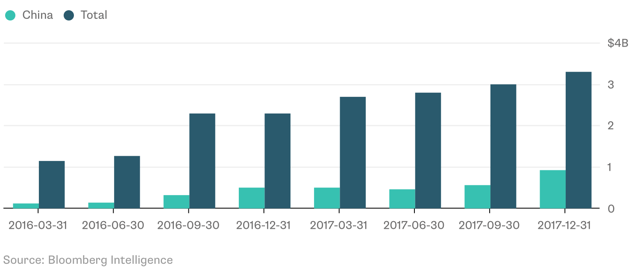
It is well known that Tesla has been negotiating for a gigafactory in Shanghai. Panasonic and Tencent (OTCPK:TCEHY) are both potential capital-raising partners. Those who say Tesla is failing in China are wrong. Its sales figures illustrate this:

2015 = US$318.5 million.

2016 = US$1.07 billion.

2017 = US$2.03 billion.

The illustration below emphasises the increasing importance of China for Tesla:
Bloomberg

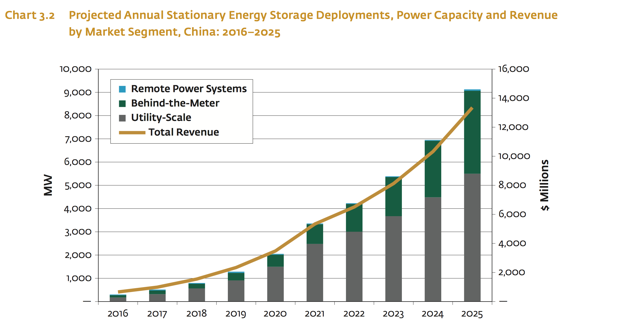
However, to get the economies of scale needed, Tesla needs a large presence within China. The same is true of Europe. It needs to be less reliant on a U.S. market where new energy products may develop less rapidly than elsewhere for political reasons. It may be that individual States in the USA will continue to drive the business. However, because of the U.S. government's environmental policies, China is the long-term golden opportunity. As my article in November detailed, Asia is now the world's largest market for renewables. It is not just China. Huge opportunities arise in India, Japan and elsewhere in the world's most populous and fastest-growing continent.

The detail below from the World Bank is telling:
World Bank

This explains why BYD and others are investing rapidly in new battery gigafactories. It does not of course take into account the rapid rise in demand that will be necessitated by EVs as well.

CATL has been a fast-growing new battery manufacturer in China. It is the country's largest. It is currently building a new 24GWh factory. By 2020, it is expected to have 88GWH capacity. By comparison, BYD will have 60 GWh by then. Some observers reckon BYD missed a beat by allowing CATL to overtake it in size. However, it should be noted that BYD has been investing in many new areas. This includes the Skytrain business and overseas e-bus and e-truck factories.

BYD's current battery manufacturing capacity totals 16 GWh. That is enough to power 1.2 million hybrids. With the Xining facility, battery capacity by 2020 should amount to supply to 2.2 million EVs. That would be about US$24 billion in sales revenue in two years. With revenue forecast for US$21.5 billion this year, that could lead to a doubling in revenue by 2020. That would put the company partly on its way to targeting a ten-fold increase by 2025 as battery production ramps up.

BYD has the advantage of meeting its own usage in both cars and new energy products. It is now targeting supplying increasingly to outside companies. The Chinese Government has a target for EV sales to reach 2 million by 2020.

Currently, BYD manufactures prismatic LiFEPO4 (lithium ferrophosphate) cells. These differ from the standard auto industry NCA (nickel, cobalt and aluminium) and NMC (nickel, manganese and cobalt) cells. These have lower conductivity than some other types but are low in toxicity and have stable long-term performance. Next year it is expected it will start manufacturing its new more advanced NMC811 battery. Other new types are under development.

China is winning dominance of the industry from source. Chinese companies are winning control of the world's cobalt supplies, which mainly come from the Congo. Four-fifths of cobalt sulphates and oxides for cathodes used in lithium batteries are manufactured in China. It is estimated that the use of cobalt in EVs will rise from 9,000 tonnes in 2017 to 107,000 tonnes in 2026. Additionally, BYD has invested in a lithium processing venture in Qinghai.

Second Life Battery Capacity

Lithium batteries will have a long potential life after their usage in EVs has expired. This has been calculated to be a potential US$550 billion industry in the future. 3.4 million lithium battery packs will be recycled annually by 2025. That number will rise exponentially as EV usage increases. The expected usage is illustrated below:
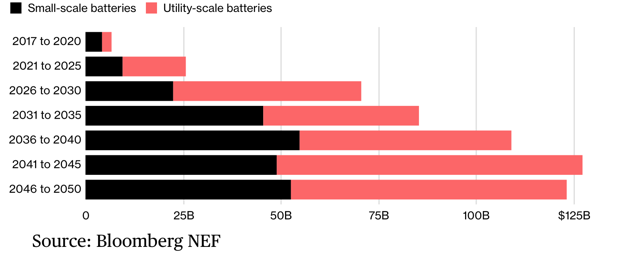
Bloomberg

Autos have become the largest users of lithium batteries, overtaking consumer electronics. The breakdown of usage is illustrated below:
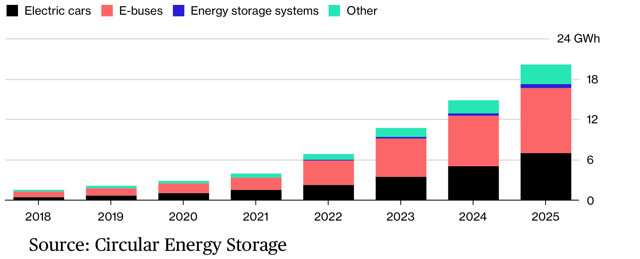
Bloomberg

As my recent article on e-buses detailed, BYD is a world leader in e-buses as well as being the world's largest EV auto manufacturer. So it will have huge capacity of second use lithium batteries in the near future. Far more cells are used in e-buses than autos. The company is opening a battery recycling plant in Shanghai. This is partly in response to Chinese Government directives concerning EV battery waste. It is also an economic opportunity.

Used batteries can be recovered and stripped down for their valuable metals. For BYD, a more likely option is large-scale usage for energy storage. Battery cells are the main cost in energy storage systems. So this should be a profitable business for BYD. When the batteries are no longer efficient for EV use, they still have 60% to 70% charge remaining. This would remain fairly constant for a long period of time. The relative value of the metals in the cells would be very low compared to what is likely to be continuing rising cost of minerals for new batteries.

The company has been expanding strongly into residential and commercial (up to grid scale) energy storage solutions, especially in Europe and Asia. It recently showcased a whole new modular range for the European market. Like Tesla, it has targeted Australia in the last year or so. My article in November last year detailed the huge opportunities for companies such as BYD and Tesla in this arena.

BYD also has a thriving solar panel business on an international scale. A recent indication of this was its US$30 million contract in Queensland for a 75 MW PV project. This shows the synergies in a country where BYD is very actively promoting its energy storage business.

Battery Plants in Europe

It has been reported that BYD is looking to set up a battery plant in Europe. It already has e-bus plants in Hungary and France, and a joint venture plant in the U.K.

A recent EU policy document calculated that the EU would need 22GWh by 2025. That would be equivalent to ten gigafactories. The EU has been discussing incentives for huge plants with the major battery players. So far there has been a lack of firm contracts. The EU has a target of getting 50% of its energy needs from renewables by 2030. So the demand for batteries in the next decade will be huge.

A report last week suggested Tesla is close to signing up for a 129 MWh battery to power a huge solar plant in S-E England. The plant is estimated to cost 拢400 million (US$524 million). If it comes to fruition, it would be three times the size of the world's largest battery installed last year by Tesla in South Australia. Planning permission is still some way off though.

This is another indication of how mistaken are those Tesla bears who even consider that Tesla should get out of the energy storage business altogether. An article on Seeking Alpha recently predicted that Tesla would exit the business. Given the huge potential seen by companies such as Tesla and BYD, this is a remarkable thesis. Especially so when you consider that energy storage is Tesla's fastest-growing sector, and the company has predicted it could exceed its auto business.

My article in May outlined the huge market opportunities for Tesla. The latest contract win in California is just another example of this. As Tesla increasingly sees itself as a battery business that sells autos, an exit from the business can be put down as a non-starter.

BYD Stock Price

BYD is expected to spin off its battery business into a separate unit to be floated on the stock market. This could add very meaningful value to stockholders. It is likely to happen in early 2019 but is not confirmed at this time.

The stock price has been hit recently by two main factors. Firstly, uncertainty over the direction of EV incentives in China. This concern proved to be misplaced. Secondly, it has been hit by the protectionist measures being brought in by the Trump administration.

It has still been a good investment for those with a long-term perspective such as major investor Berkshire Hathaway (BRK.A) (NYSE:BRK.B). The 5-year chart below illustrates this:
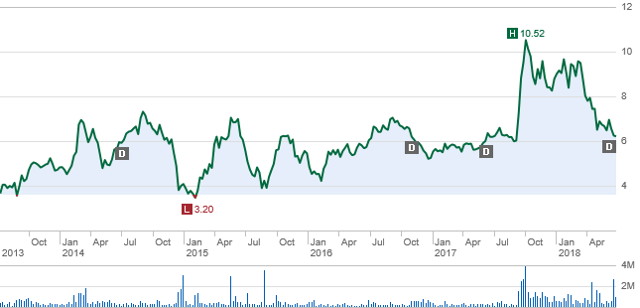
Charles Schwab

My recent article highlighted why it can be seen as an excellent Buy after these pullbacks. The best timing of buying stock is uncertain, however. There are of course risks, as I detailed in an article in September last year. Since then the major risk has become the trade war instituted by the USA against China and the EU.

CEO and founder Wang Chuanfu is not given to hyperbole. His target to increase revenues from US$17 billion to US$151 billion by 2025 is a serious intent, whether or not it is successful.

For investors looking to play the long game, now represents an opportunity despite what may be short-term hiccups. Those who are more risk-averse may want to wait and see what happens in the trade wars narrative. BYD is not directly affected in that it does not export autos to the USA. Indeed it makes e-buses there. It is though likely to be hit by negative sentiment for autos in particular, and for Chinese stocks in general. In my article in January, I detailed some of the general risks inherent in Chinese stocks.

As for Tesla, the China potential emphasises the added importance of having investments on the ground in China. Tesla celebrated when China recently cut auto import tariffs. It cut the price of its autos in the Chinese market. Now the U.S. government's stance towards China has led to a new tariff in retaliation from the Chinese government. It is a classic example of how the USA's tariffs policy is hurting U.S. manufacturers and encouraging them to relocate production overseas. This was seen recently with Harley-Davidson (HOG) and with warnings from GM (GM).

Conclusion

For strategic, environmental and political reasons, China is seizing the world market for EVs and for batteries. On manufacturing grounds it has mapped out a very strong position for itself. The USA is far behind the curve. It will likely become more so given the stand on environmental matters by the Trump Administration.

On the auto front, there is of course plenty of room for both BYD and Tesla to thrive. This is true in China, in Europe and around the world. Tesla's marketing has been based on starting from the top and working downwards. BYD has achieved huge EV volumes based on fleet sales and is now working up in quality. Both have huge potential as the world moves towards an EV and energy storage future. Both will need substantial investments in battery manufacturing. This will keep them vertically integrated and able to control their own costs, and open up substantial sales to outside parties.

Tesla will probably further develop its business successfully. Its lack of finance compared to BYD will be a hindrance to reaching its full potential. However, the recent announcement by Panasonic shows there is not a lack of willing suitors. Chinese giant Tencent may well invest further in the company.

Both Tesla and BYD have what I look for in a company. That is, inspiring management with involvement in a secular growth sector.

On a world stage, Tesla is unlikely to achieve the volumes of BYD in either EVs or batteries. The growth market is so huge though that Tesla will still be a major player.

BYD has the financial advantage over Tesla. It has the economies of scale and the advantage of being located in China with a supportive, environmentally concerned government. BYD is well-placed to consolidate its position as the vertically integrated world market leader in the new energy sector.

Disclosure: I am/we are long BYDDF, TSLA.

I wrote this article myself, and it expresses my own opinions. I am not receiving compensation for it (other than from Seeking Alpha). I have no business relationship with any company whose stock is mentioned in this article.

Editor's Note: This article discusses one or more securities that do not trade on a major U.S. exchange. Please be aware of the risks associated with these stocks.

Tuesday, June 19, 2018

Rayonier Advanced Materials Inc (RYAM) Shares Sold by JPMorgan Chase & Co.

JPMorgan Chase & Co. cut its stake in Rayonier Advanced Materials Inc (NYSE:RYAM) by 13.5% in the first quarter, according to the company in its most recent disclosure with the Securities and Exchange Commission. The institutional investor owned 767,537 shares of the basic materials company’s stock after selling 120,074 shares during the period. JPMorgan Chase & Co.’s holdings in Rayonier Advanced Materials were worth $16,480,000 at the end of the most recent reporting period.

A number of other institutional investors also recently modified their holdings of the business. Oaktree Capital Management LP purchased a new position in shares of Rayonier Advanced Materials during the 4th quarter worth approximately $31,850,000. Restructuring Capital Associates LP purchased a new position in shares of Rayonier Advanced Materials during the 4th quarter worth approximately $14,926,000. BlackRock Inc. increased its stake in shares of Rayonier Advanced Materials by 9.1% during the 4th quarter. BlackRock Inc. now owns 6,214,366 shares of the basic materials company’s stock worth $127,083,000 after purchasing an additional 520,554 shares in the last quarter. WBI Investments Inc. purchased a new position in shares of Rayonier Advanced Materials during the 1st quarter worth approximately $7,423,000. Finally, Linden Advisors LP increased its stake in shares of Rayonier Advanced Materials by 141.2% during the 4th quarter. Linden Advisors LP now owns 540,415 shares of the basic materials company’s stock worth $11,051,000 after purchasing an additional 316,336 shares in the last quarter. 92.38% of the stock is owned by institutional investors.

Get Rayonier Advanced Materials alerts:

A number of research analysts have recently weighed in on the stock. Vertical Research raised shares of Rayonier Advanced Materials from a “hold” rating to a “buy” rating in a research note on Wednesday, May 9th. Bank of America raised their price objective on shares of Rayonier Advanced Materials from $23.00 to $25.00 and gave the stock a “buy” rating in a research note on Wednesday, February 21st. Zacks Investment Research raised shares of Rayonier Advanced Materials from a “hold” rating to a “buy” rating and set a $22.00 price objective for the company in a research note on Friday, May 11th. Finally, ValuEngine cut shares of Rayonier Advanced Materials from a “strong-buy” rating to a “buy” rating in a research note on Thursday, April 12th. One analyst has rated the stock with a sell rating, one has given a hold rating and six have assigned a buy rating to the company. Rayonier Advanced Materials currently has an average rating of “Buy” and a consensus target price of $21.00.

Shares of Rayonier Advanced Materials opened at $17.02 on Monday, according to Marketbeat.com. The company has a market cap of $882.80 million, a P/E ratio of 17.55, a PEG ratio of 0.44 and a beta of 3.43. Rayonier Advanced Materials Inc has a 1 year low of $12.68 and a 1 year high of $22.96. The company has a current ratio of 2.06, a quick ratio of 1.01 and a debt-to-equity ratio of 1.70.

Rayonier Advanced Materials (NYSE:RYAM) last released its quarterly earnings results on Monday, May 7th. The basic materials company reported $0.38 EPS for the quarter, missing analysts’ consensus estimates of $0.45 by ($0.07). The company had revenue of $522.00 million during the quarter, compared to analysts’ expectations of $522.14 million. Rayonier Advanced Materials had a net margin of 26.52% and a return on equity of 15.39%. The company’s quarterly revenue was up 4.0% compared to the same quarter last year. During the same period in the previous year, the company posted $0.15 earnings per share. sell-side analysts anticipate that Rayonier Advanced Materials Inc will post 1.92 earnings per share for the current year.

The business also recently declared a quarterly dividend, which will be paid on Friday, June 29th. Investors of record on Friday, June 15th will be given a $0.07 dividend. This represents a $0.28 dividend on an annualized basis and a yield of 1.65%. The ex-dividend date is Thursday, June 14th. Rayonier Advanced Materials’s payout ratio is currently 28.87%.

Rayonier Advanced Materials announced that its board has approved a share repurchase plan on Tuesday, February 20th that authorizes the company to repurchase $100.00 million in shares. This repurchase authorization authorizes the basic materials company to repurchase shares of its stock through open market purchases. Shares repurchase plans are often a sign that the company’s management believes its stock is undervalued.

Rayonier Advanced Materials Company Profile

Rayonier Advanced Materials Inc manufactures and sells cellulose specialty products in the United States, China, Japan, Europe, Latin America, other Asian countries, Canada, and internationally. The company operates through High Purity Cellulose, Forest Products, and Pulp & Paper segments. Its products include cellulose specialties, which are natural polymers that are used as raw materials to manufacture a range of consumer-oriented products, such as cigarette filters, liquid crystal displays, impact-resistant plastics, thickeners for food products, pharmaceuticals, cosmetics, high-tenacity rayon yarn for tires and industrial hoses, food casings, paints, and lacquers.

Want to see what other hedge funds are holding RYAM? Visit HoldingsChannel.com to get the latest 13F filings and insider trades for Rayonier Advanced Materials Inc (NYSE:RYAM).

Institutional Ownership by Quarter for Rayonier Advanced Materials (NYSE:RYAM)